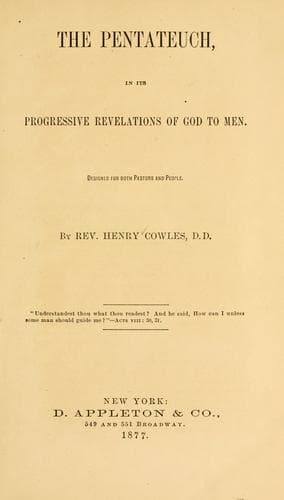
The Pentateuch, in Its Progressive Revelations of God to MenCowles, Henry
Religion
The Pentateuch, in Its Progressive Revelations of God to Men
Cowles, Henry
Bible. Pentateuch -- Criticism, interpretation, etc.
In Deut. 21: 18–21, the case is supposed of a son incurably stubborn,
rebellious, gluttonous, and drunken, upon whom parental chastisement
is unavailing. The law very considerately provides that his father and
his mother shall lay hold of him and bring him before the elders of his
city unto its gates (_i. e._ into open court), and there, as a public
example and warning, the men of his city shall stone him with stones
that he die:――“So shalt thou put evil away from you and all Israel
shall hear and fear.”――――Parental love and partiality would guaranty
this law against abuse. It is pleasant to note that no case of its
execution is on record. Perhaps the severity of the law forestalled its
violation.――――The spirit of this precept is so fully in harmony with
the book of Proverbs that we naturally expect to find it there. (See
Prov. 20: 20 and 30: 11, 17.)
A precept forbidding insult and reproach of magistrates stands in Ex.
22: 28: “Thou shalt not revile the gods [Elohim used probably in the
sense of _judges_], nor curse the ruler of thy people.” The word “gods”
here can not refer to false gods, idols (as the English reader might
suppose), for the Hebrew word can not bear that sense, nor would it be
pertinent. The parallelism with “ruler of thy people” favors the sense
above suggested――_judges_――acting under God and in his behalf before
the people. Their sacred office under God is assumed to be good reason
for treating them with respect and against offering them insult.――――No
penalty is attached to the violation of this law――perhaps because
the penalty ought to depend so much upon the aggravation of the
offense.――――Under the kings, it was apparently a capital crime, for
when Shimei cursed king David (2 Sam. 19: 21–23) Abishai assumed that
he ought to die; and his temporary pardon was manifestly due to David’s
sad consciousness of deep personal ill-desert and of God’s righteous
visitations upon him.
III. _Crimes against Person and Life_;
(Violations of the Sixth Command).
Under this head the salient and vital points are:
1. That the _real murderer must be put to death_, and no “satisfaction”
be ever taken in place of his life.
2. That the law discriminated with the utmost care and wisdom between
real murder, and homicide, more or less justifiable. [Special laws
touching injuries done to servants will be treated under the head of
Hebrew servitude.]
3. A special law provided cities of refuge.
4. Another special law met the case of murder by unknown hands.
5. Inexcusable carelessness causing injury or death was punished.
6. Personal injuries not fatal were specially punished by statute.
Public-domain text, read in full here on John Shaqi.
Reviews
Reviews
No reviews yet
Be the first to share your thoughts on this work.
Elsewhere in the archive
Join the Discussion
Join the discussion
Sign in to leave a comment or review.
Sign InorCreate an account