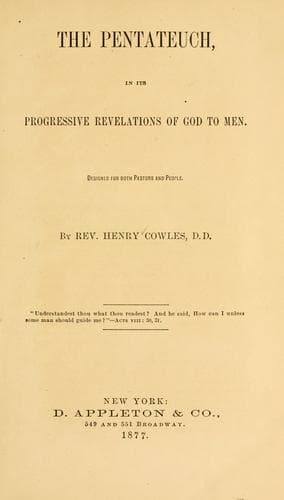
The Pentateuch, in Its Progressive Revelations of God to MenCowles, Henry
Religion
The Pentateuch, in Its Progressive Revelations of God to Men
Cowles, Henry
Bible. Pentateuch -- Criticism, interpretation, etc.
1. Real murder was punished capitally. “He that smiteth a man so that
he die shall be surely put to death” (Ex. 21: 12 and Lev. 24: 17).
The law appears fully in Num. 35: 9–34 and Deut. 19: 4–13, 20, 21,
in connection with provisions for the cities of refuge. With firm and
solemn tone the law declared “Ye shall take no satisfaction for the
life of a murderer who is guilty of death, but he shall be surely put
to death. So shall ye not pollute the land wherein ye are; for blood
it defileth the land, and the land can not be cleansed of the blood
that is shed therein but by the blood of him that shed it. Defile not
therefore the land which ye shall inhabit wherein I dwell, for I the
Lord dwell among the children of Israel” (Num. 35: 31–34).――――This
reaffirms and amplifies the doctrine of the law as given to Noah and to
the repeopled world; “And surely your blood of your lives [life-blood]
will I require at the hand of every beast will I require it, and _at
the hand of every man_; at the hand of every man’s brother [such a case
as that of Cain and Abel] will I require the life of man. Whoso [with
no exception] sheddeth man’s blood, by man shall his blood be shed;
_for in the image of God made he man_.” Human life is sacred, and God
protects it under the sternest possible penalties――nothing less than
the life of the murderer. That God intended this law _for the whole
race, for the entire repeopled world_ from and after Noah, is too plain
to be denied or even doubted. It is not easy to see how another word
could be said to make this more plain. The law of Sinai and the code
given through Moses are intensely emphatic, indeed, perfectly decisive.
The law does not prescribe the mode of this capital punishment. In
various other crimes punishable with death, the mode is by stoning,
done, however, not by any one executioner, but by many; in some
cases by “the men of the city.” The penalty for murder would often be
executed by the blood-avenger――the nearest relative of the murdered man;
and it seems to be assumed that he would use any deadly weapon he might
choose (Num. 35: 19, 21, 27 and Deut. 19: 6, 11–13).
2. The law discriminated with the utmost care and wisdom between real
murder, and homicide, more or less justifiable. Real murder was to be
proven as follows:
(1.) By previous hatred and enmity. Of course this could be known by
human judges only by its manifestations.
(2.) By violent passion in the act――which I take to be the sense of
the words in our translation: “If a man come _presumptuously_ upon his
neighbor; [in Heb.] if a man _boil up with rage_ against his neighbor
to slay him with guile,” etc. (Ex. 21: 14).
(3.) By evidence of premeditation――“lying in wait” (Ex. 21: 13, and
Num. 35: 15–23, and Deut. 19: 4–6).
(4.) By the sort of instrument used (Num. 35: 16–18). “An instrument of
iron;” “a stone;” “a hand-weapon of wood,” _i. e._ _wood of the hand_,
large enough to fill the hand and deal a death-blow.
Public-domain text, read in full here on John Shaqi.
Reviews
Reviews
No reviews yet
Be the first to share your thoughts on this work.
Elsewhere in the archive
Join the Discussion
Join the discussion
Sign in to leave a comment or review.
Sign InorCreate an account