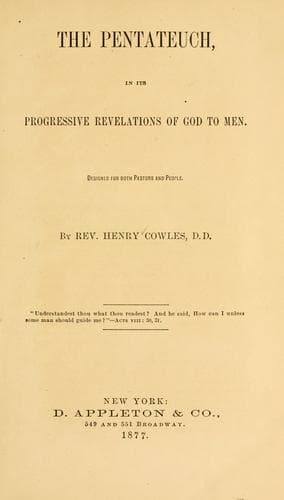
The Pentateuch, in Its Progressive Revelations of God to MenCowles, Henry
Religion
The Pentateuch, in Its Progressive Revelations of God to Men
Cowles, Henry
Bible. Pentateuch -- Criticism, interpretation, etc.
On the other hand it would be in favor of homicide if one had killed
his neighbor “ignorantly”――“whom he had not hated in time past;” or
thrust upon him suddenly without enmity; without lying in wait; or
cast upon him a stone seeing him not, nor seeking his harm, etc. (Num.
35: 22, 23 and Deut. 19: 4–6). A case for example is given――the head
of a man’s ax flying off when he is at work and killing his neighbor.
3. A special law provided for _cities of refuge_. (See Ex. 21: 13 and
Num. 35, and Deut. 19 and Josh. 20).――――At the era of Moses it was
already a time-honored usage that the nearest blood-relative should
avenge the blood of his slain friend. The prevalence and strength
of this sentiment were due of course, primarily, to the instincts
of human nature; but secondarily to the fact that as an institution
for the protection of person and life, the family was prior to the
state.――――The Goel [as he was called in Hebrew]――the blood-avenger
or Redeemer, could not be expected to exercise cool and impartial
discrimination over the questions lying between murder in the
first degree and homicide. To obviate this evil the Lord introduced
an important modification upon the previously current usages of
blood-revenge. It was this. Six cities in Palestine――three on each side
of the Jordan were selected in such convenient geographical position
that from any point of the whole country the man-slayer might make the
nearest one within less than one day’s run.――――All these were cities
of the Levites; hence the leading men of the city would be competent
to hold a preliminary investigation. The man-slayer fled for his life
to the nearest of these cities. The legal authorities there protected
him against the Goel――the blood-avenger. The elders of his own city,
if the case seemed to demand it, might send and fetch him; try him, and
deliver him up to the blood-avenger; or remand him back to his city of
refuge. Thus this city shielded him against sudden and indiscriminate
vengeance, and secured for him a trial before the congregation or
elders of his own city. If his case was proved to be homicide, he
must remain within the city of refuge till the death of the high
priest, after which the avenger’s right to take his life (outside
the refuge-city) ceased and he could go at large in safety. This
provision affixed a limit to his quasi-imprisonment. Perhaps it was
also significant of the pardon for sin provided for in the death of our
Great High Priest.――――If the man-slayer allowed himself to be caught
by the blood-avenger outside his city when he should be within it, the
avenger might take his life with impunity.
Public-domain text, read in full here on John Shaqi.
Reviews
Reviews
No reviews yet
Be the first to share your thoughts on this work.
Elsewhere in the archive
Join the Discussion
Join the discussion
Sign in to leave a comment or review.
Sign InorCreate an account