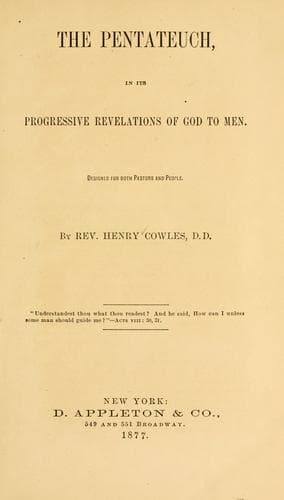
The Pentateuch, in Its Progressive Revelations of God to MenCowles, Henry
Religion
The Pentateuch, in Its Progressive Revelations of God to Men
Cowles, Henry
Bible. Pentateuch -- Criticism, interpretation, etc.
In the later books (Lev. 25: 35–38 and Deut. 23: 19, 20) we have
perhaps a later and revised form of the statute. “If thy brother
be waxen poor, thou shalt relieve him. Take thou no usury of him or
increase; fear thy God, that thy neighbor may live with thee. Thou
shalt not give him thy money upon usury, nor lend him thy victuals
for increase.” In Deut. (as above) the law discriminates between “thy
brother” and a stranger. “Thou shalt not lend upon usury to thy brother;
unto a stranger thou mayest lend upon usury.” The ground for this
discrimination against the stranger may be a purpose to discourage his
residence in the land; or it may be related to the general fact that
foreigners were the men of traffic. (The original words for Canaanite
and for merchant were the same.) Tradesmen, doing business on borrowed
capital, might afford to pay interest; and on every principle of right
and justice, ought to do so. But God did not encourage the Israelites
in traffic with other nations. It would have been quite too perilous to
their morals, and to their religion.
The reader will scarcely need the suggestion that the Hebrew law
against interest applies in our Christian age only to the case of
loans made to the poor to meet their necessities. The spirit of the
law unquestionably _does_ apply in such cases, and does _not_ apply to
any other.
(4.) _Many special statutes contemplated relief for the poor._――――The
corners and the gleanings of the harvest field; a forgotten sheaf; a
few clusters of grapes also and some olives on the olive tree, must
be left for the poor and the stranger (Lev. 19: 9, 10, and 23: 32, and
Deut. 24: 19–22)――each of these successive statutes adding somewhat
in detail to the preceding.――――The day wages of the poor laborer must
be promptly paid, even on the very same day (Lev. 19: 13 and Deut. 24:
14, 15). But especially the sabbatic year (each seventh) was designed
to be a special benefaction to the poor. This law (Deut. 15: 1–11)
uses chiefly the word “release” in regard to the debts of the poor.
Critics are sharply divided over the question whether this release was
an entire _remission of debts_, or only a _stay of collection_, putting
it over for this one year. In favor of the latter view, Michaelis
and others urge that the reason for stay of collection was that
no cultivation of land was permitted during this year, and hence
there were no crops of this sort, and therefore only diminished means
of paying debts. Also that the law might be so abused as mostly to
annihilate all rights of property, inasmuch as the statute (v. 9) would
virtually put the property of the more wealthy within the control of
the less wealthy. Thou shalt not withhold because the year of release
is at hand, etc.
On the other hand, the arguments for construing the law to mean an
actual release of debt in the case of “thy poor brother” or neighbor,
are strong, and in my view, conclusive; _e. g._
Public-domain text, read in full here on John Shaqi.
Reviews
Reviews
No reviews yet
Be the first to share your thoughts on this work.
Elsewhere in the archive
Join the Discussion
Join the discussion
Sign in to leave a comment or review.
Sign InorCreate an account