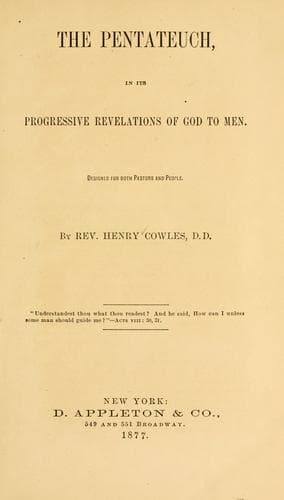
The Pentateuch, in Its Progressive Revelations of God to MenCowles, Henry
Religion
The Pentateuch, in Its Progressive Revelations of God to Men
Cowles, Henry
Bible. Pentateuch -- Criticism, interpretation, etc.
(a.) This is the legitimate meaning of the original word translated
“release.” There should never be any deviation from the legitimate
sense of the original staple word, without cogent reasons――a principle
which is doubly strong _in the words of a law_.
(b.) This construction is fully in harmony with the genius of the
entire code in all its statutes for the relief of the poor.
(c.) On this construction the limitations of the statute are precisely
in place; _e. g._――to the case of “thy poor brother.” “Thou shalt
release _save when there_ shall be no poor among you”: also――“If there
be among you a poor man of one of thy brethren, etc., thou shalt not
harden thy heart nor shut thy hand from thy poor brother, but shalt
open thy hand wide unto him, and shall surely lend unto him sufficient
for his need in that which he wanteth”――[not all your property: you are
not required to make over every thing you have]. “Beware that there be
not a thought in thy wicked heart, saying――The year of release is at
hand” [and I shall never get my money or my grain back again], “and he
cry unto the Lord against thee, and it be sin unto thee.” This shaping
of the statute plainly contemplates a real remission of this sort of
debts on each seventh year.
(d.) To the same purport is this――that the law excepts debts against a
foreigner: “Of a foreigner thou mayest exact it.” Our translators have
taken the liberty to add the word “again,” but without the least
authority from the Hebrew. The word “again” seems to come from the
theory that this statute required a stay of collection for one year in
the case of the foreigner: but of this there is no proof in the law as
it came from the hand of Moses.――――In the time of Nehemiah (5: 1–12)
there was unquestionably an entire remission of debts to the poor, and
not the least hint that this was going beyond the Mosaic law. On the
contrary it is implied that “the fear of our God” (v. 9)――equivalent
to obedience――would require just this.
This seventh or sabbatic year had other special features besides
the remission of the poor man’s debts as in Deut. 15: 1–11. These
additional features appear in Lev. 25, which provides (vs. 2–7) that
this year shall be a Sabbath of rest to the soil――rest from its usual
cultivation.――――In this chapter we find also a kindred institution――the
Jubilee――each fiftieth year――next following each seventh Sabbatic
year. Inasmuch as this arrangement would bring two years of land-rest
together, the Lord gave a special promise that the fertility of the
year immediately preceding should suffice against the necessities of
these two years of rest――a fact which testifies that God ruled his
people Israel under a system of special providences. If Moses is to be
considered as even in a secondary sense the legislator of the people,
he must have had unbounded confidence in God’s special direction and
counsel in these statutes.
Public-domain text, read in full here on John Shaqi.
Reviews
Reviews
No reviews yet
Be the first to share your thoughts on this work.
Elsewhere in the archive
Join the Discussion
Join the discussion
Sign in to leave a comment or review.
Sign InorCreate an account