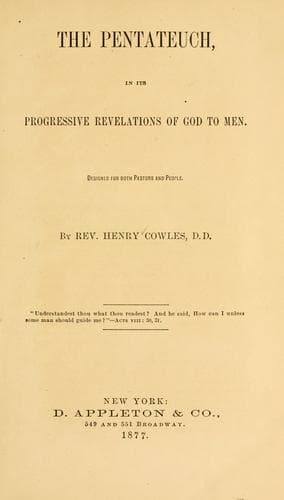
The Pentateuch, in Its Progressive Revelations of God to MenCowles, Henry
Religion
The Pentateuch, in Its Progressive Revelations of God to Men
Cowles, Henry
Bible. Pentateuch -- Criticism, interpretation, etc.
Let it be noticed, the law assumes that possibly the servant may love
his wife and his children and even his _master_ so well that he chooses
not to leave them. Very well; if he will consent to come before the
judges and in a solemn judicial manner, testify to this love of his
heart, and moreover, will consent to endure the rather uncomfortable
operation of having his ear bored through with an awl, then he may
remain forever――_i. e._ during life. But the discomforts of this
operation were intended to bear somewhat against this unlimited
servitude. The law seemed to say to every servant――“It would probably
be better for you to be your own master and live in freedom, rather
than in even this very comfortable servitude.”――――Every provision
of this statute had a purpose. The servant must be brought before
the judges to express in this public manner his choice to remain in
servitude; for this method would make it impossible for the master to
misrepresent the will of his servant. Moreover, it seems probable that
boring the ear was no badge of honor but the opposite, and therefore
would bear against the man’s choice of perpetual servitude.
The law made special provision for the case of female servants. The
original statute (Ex. 21: 7–11) put her case on a different footing
from that of her brother. “She shall not go out as the men-servants do.”
The language――“If a man sell his daughter to be a maid-servant”――may
seem at first view to be a case of slave-sale, involving real property
in human flesh and bones. A closer examination will show that it
comes under the usage of _selling daughters to become wives_; for this
purchase “betrothed her to her master,” or to “his son,” and the law
made special provision for her rights as such; viz. that in case her
master is not pleased with her, he shall let her be redeemed, “and
shall have no power to sell her unto a strange nation.” If betrothed
to his son, he shall deal with her as with a daughter; if the son take
another wife, he shall not abate from his duty as a husband toward her;
and if he refuse to do all the law demands, she is free――redeemed by
law, “without money.”――――These statutes of course shape themselves
to the existing usages in respect to polygamy, concubinage, and easy
divorce, sedulously protecting the rights of a female servant under
these most unfavorable usages.
It seems probable that these kind and considerate provisions failed
to protect her rights as fully as the spirit of the law intended, and
therefore a further modification appears at a later period; for Deut.
15: 17 declares that the six years’ emancipation law shall apply to her
also as truly as to her brother;――“and unto thy maid-servant thou shalt
do likewise.”
Public-domain text, read in full here on John Shaqi.
Reviews
Reviews
No reviews yet
Be the first to share your thoughts on this work.
Elsewhere in the archive
Join the Discussion
Join the discussion
Sign in to leave a comment or review.
Sign InorCreate an account