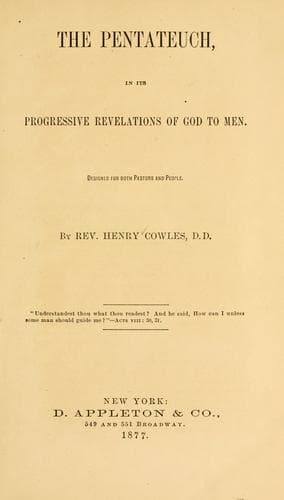
The Pentateuch, in Its Progressive Revelations of God to MenCowles, Henry
Religion
The Pentateuch, in Its Progressive Revelations of God to Men
Cowles, Henry
Bible. Pentateuch -- Criticism, interpretation, etc.
5. In view of the fact that what we may call “religious privileges”
included rest from labor and more or less of religious and social
festivity, the law was very specific in stipulating that the
man-servant and the maid-servant must share in all these equally with
the son and the daughter. We see this in the law of the Sabbath; in
the feast upon the second tithes (Deut. 12: 17, 18); and in two of the
great festivals, viz. the Pentecost and the Feast of Tabernacles (Deut.
16: 11, 14).――――Thus they were put religiously and socially upon the
same footing as children in the family. No ban of exclusion, no stigma
of caste, could attach to their condition so long as these statutes
were duly observed.
6. By usage and without the necessity of statute, Hebrew servants
held property. The old American doctrine――“The slave can own
nothing”――had no place in the system of Hebrew servitude. The proof
is twofold:――――(a) The statutes provided that “if able he might redeem
himself” (Lev. 25: 49). This permission would be only a taunting insult
if in fact no Hebrew servant could hold property.――――(b). The light
of history bears witness: Ziba was a servant of the house of Saul; but
he had servants under him――a round score; “fifteen sons and _twenty_
servants” (2 Sam. 9: 10 and 19: 17), and seems to have had charge of
cultivating Saul’s estates.
Thus manifold and effective were the humane provisions which softened
the severities of slavery, toning them down to a very tolerable system
of servitude.
_The Slavery that Existed before Moses._
We have spoken of Hebrew servitude as a _modified_ system――which
raises the question――“modified” _from what_? What was the pre-existing
system upon which these modifications were superinduced? A full answer
must include (a) The patriarchal system as it appears in the case of
Abraham, Isaac, and Jacob: and (b) The system of Egypt and perhaps
other contemporary nations.
Public-domain text, read in full here on John Shaqi.
Reviews
Reviews
No reviews yet
Be the first to share your thoughts on this work.
Elsewhere in the archive
Join the Discussion
Join the discussion
Sign in to leave a comment or review.
Sign InorCreate an account