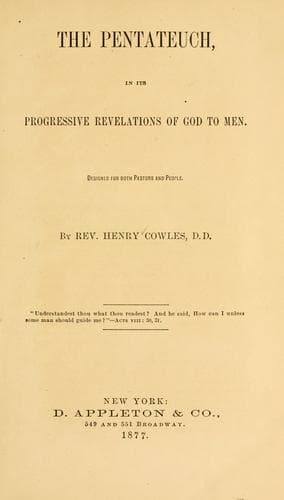
The Pentateuch, in Its Progressive Revelations of God to MenCowles, Henry
Religion
The Pentateuch, in Its Progressive Revelations of God to Men
Cowles, Henry
Bible. Pentateuch -- Criticism, interpretation, etc.
(a.) In the patriarchal system servitude could not possibly have been
compulsory. It must have been voluntary. Force, coercion, was utterly
out of the question. Abraham had neither army nor police to hold his
slaves in bondage. In fact they were his armed soldiers as against
freebooting incursions or any hostile assault whatever. Manifestly
they lived with him while they chose――no longer. Some of them rose to
bear important responsibilities, _e. g._ Eliezer (Gen. 24); his two
young men who went with him and Isaac to Moriah (Gen. 22).――――Isaac
“had great store of servant” (Gen. 26: 14), but there is not the
least intimation that they were entailed as part of his estate to
either Esau or Jacob; or that he received them by inheritance from
Abraham.――――Jacob had many servants (Gen. 30: 43), and in fact must
have had to help him in the care of his flocks and herds: but the
history shows that he did not take them with him into Egypt. Joseph’s
invitation left out the servants (Gen. 45: 10, 11.), and the record
specifies all the family except the servants and gives us the actual
enumeration――all servants omitted (Gen. 46: 5–26). Property in servants
in the American sense, there was none.
(b.) Of Egyptian slavery enough is known to show that they bought
slaves brought in from other nations, holding therefore a property
right in them, and that they constituted a menial class in society.
* * * * *
The condition of the Israelites under oppression there was peculiar.
Manifestly they were not held by individual Egyptians as their
personal property, but rather by the crown. The king of Egypt appears
as the great slave-holder of the Hebrew people, making levies upon
them for laborers at his pleasure, and exacting the severest tasks
with no limitations but his own will on the one hand and their possible
endurance on the other. The question of letting the people go was (at
least mainly) personal to himself and to his throne. His merciless
severity would naturally tend to make slavery in Egypt heartlessly
cruel. Laws to restrain masters from severity could not be thought
of under such kings. It is easy to see that when, at and after Sinai,
the Lord came to legislate for the Hebrew people, fresh from Egyptian
usages and laws, there was abundant occasion for statutes to modify
the severities of human bondage. With telling force the Lord could
say――Never oppress your servants; ye know how oppression feels!
_The Jubilee._――(Lev. 25).
In this chapter and here only we have an account of this peculiar
institution. The following points in it deserve special attention.
Public-domain text, read in full here on John Shaqi.
Reviews
Reviews
No reviews yet
Be the first to share your thoughts on this work.
Elsewhere in the archive
Join the Discussion
Join the discussion
Sign in to leave a comment or review.
Sign InorCreate an account