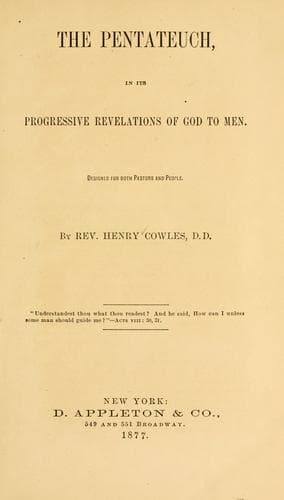
The Pentateuch, in Its Progressive Revelations of God to MenCowles, Henry
Religion
The Pentateuch, in Its Progressive Revelations of God to Men
Cowles, Henry
Bible. Pentateuch -- Criticism, interpretation, etc.
1. Its main scope and purpose were manifestly of the same sort with
those of the Sabbatic year――a year of rest from labor, of recuperation
for both the laborer and his lands, and of joy in the God of their
mercies. Particularly it made provision for restoring lands which had
been alienated by any means during the forty-nine intervening years. On
this eventful year all lands were to return to the original proprietor
and to his estate. The law provided that alienated lands might be
redeemed at any time for a price graduated by the years intervening
before the Jubilee. But if the poor man was unable to redeem his land
and had no relative or friend to redeem it for him before the Jubilee,
it then returned to him by the statute with no redemption price.
2. We must note its bearing upon Hebrew servants and its relation
to the seventh year emancipation law.――――It treats of two classes of
servants of Hebrew blood; those who had sold themselves, because of
their poverty, to a fellow Israelite; and those who for the same reason
had sold themselves to a wealthy foreigner residing in the land. As
to the former class, the law enjoins kind treatment; puts strongly
the distinction between the hired and the bond-servant――permitting
servants of Hebrew birth to be held in the former state but not in
the latter; and finally gave him and his children freedom at the
Jubilee.――――Inasmuch as the seventh year emancipation law applied to
this very class of servants, if it were enforced there could be no
Hebrew servants to go out at the Jubilee except those who had not yet
served six full years. This seems to be the bearing of the law of the
Jubilee upon Hebrew servants. We can not assume that it superseded the
seventh year law and took its place. The historic passage (Jer. 34:
8–17) would quite forbid such a construction.
As to the second class――those who had sold themselves to a
foreigner――the law gave the right of redemption to any of his friends
or to himself, and fixed the terms, providing for his freedom at the
Jubilee.
3. The most difficult point is, the bearing of the Jubilee, if any,
_upon servants of foreign birth_. Did it, or did it not, provide for
their emancipation?
Public-domain text, read in full here on John Shaqi.
Reviews
Reviews
No reviews yet
Be the first to share your thoughts on this work.
Elsewhere in the archive
Join the Discussion
Join the discussion
Sign in to leave a comment or review.
Sign InorCreate an account