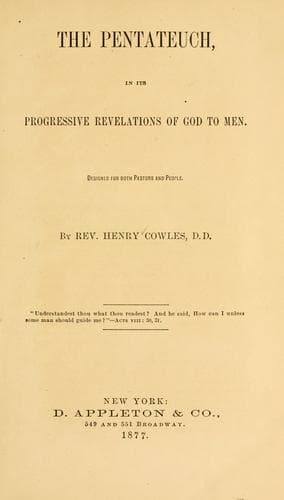
The Pentateuch, in Its Progressive Revelations of God to MenCowles, Henry
Religion
The Pentateuch, in Its Progressive Revelations of God to Men
Cowles, Henry
Bible. Pentateuch -- Criticism, interpretation, etc.
The passage (Lev. 25: 9, 10) seems very strong in favor of _universal_
liberty, not omitting bond-servants of foreign birth. The words
are――“_Proclaim liberty through all the land unto all the inhabitants
thereof_.” This proclamation was made with sound of trumpet, ringing
out its shrill blast over all the land. Now let it be considered: If
foreigners were not included, and if the seventh year emancipation
law had been duly enforced, there could have been but a meager showing
of freedmen――only those few Hebrew servants who had not filled out
their six years of service. Is it credible that so much proclamation
and so much public display could have meant only the emancipation of
say one-tenth or one-twentieth of all the servants in the land?――――At
any point of their history the number of foreign servants ought
to have greatly exceeded the number of Hebrew birth――for two
reasons:――――(a.) The law encouraged the taking of foreigners into
this relation:――――and (b.) They continued in it at least till the
Jubilee――their maximum service being therefore forty-nine years,
awhile the maximum service of the Hebrew-born was only six. Therefore
I urge that a proclamation so high sounding and in terms so absolutely
universal can not have left out the great majority of bondmen in the
land.
The opponents of this view rely upon the words (v. 46)――“They shall be
your bondmen forever”――which they claim must mean _during life_.――――But
it may be replied――One human life is very much short of _forever_. Also,
if the statute had meant during life, why did it not say so?――――Again;
the order of the Hebrew words favors this construction: “Forever of
them shall ye take servants”――or somewhat more literally: Forever
among them shall ye serve yourselves, _i. e._ provide yourselves with
servants. And this construction harmonizes fully with the drift of the
context, the spirit of which is――Go to the heathen about you, or to
heathen families living among you for your supply of bond-servants.
Let this be the permanent arrangement.
The English phrase――“bond-servant” may perhaps give a stronger sense
than the Hebrew will warrant. The Hebrew suggests no sort of “bond”――no
obligation of law or justice. It expresses a certain degree of emphasis
by means of repeating the words for service and servant, in this way:
(v. 39), If thy brother with thee shall become weak “[broken down
financially], and shall sell himself to thee, thou shalt not exact
of him the service of a servant, [or serve thyself in him with the
service of a servant].” This is all that “bond-servant” can mean. It is
a somewhat intensified idea of service.――――Another prohibition in this
passage is sufficiently explicit: “Thou shalt not rule over him _with
rigor_” (vs. 43, 46), _i. e._ literally, with crushing; shalt not break
him down; or in the American slave-holder’s phrase “break him in.”
* * * * *
Public-domain text, read in full here on John Shaqi.
Reviews
Reviews
No reviews yet
Be the first to share your thoughts on this work.
Elsewhere in the archive
Join the Discussion
Join the discussion
Sign in to leave a comment or review.
Sign InorCreate an account