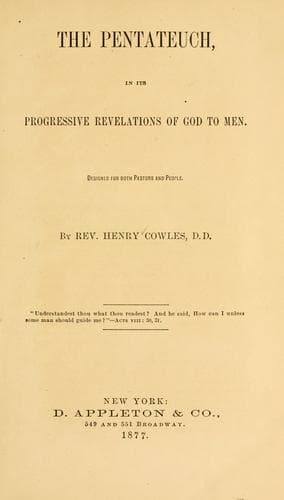
The Pentateuch, in Its Progressive Revelations of God to MenCowles, Henry
Religion
The Pentateuch, in Its Progressive Revelations of God to Men
Cowles, Henry
Bible. Pentateuch -- Criticism, interpretation, etc.
The case of _foreign servants_ demands yet a few more words of
explication. It can not be denied that the spirit of the Hebrew law
favored the choice of foreigners for servants, and the increase of
this class of population. This is plainly the doctrine of the passage
Lev. 25: 44–46.――――In connection with this we may profitably study
the law of the Passover in its relation to servants (Ex. 12: 43–49).
“There shall no stranger eat thereof, but every man’s servant that is
bought for money, _when thou hast circumcised him_, then shall he eat
thereof.”――――That this law contemplated Gentile servants is clear on
two grounds:――――(a.) Only such would need circumcision――all Hebrews
being circumcised when eight days old.――――(b.) The law (Lev. 25: 44)
required them to take their servants from the heathen, and authorized
them to “_buy_” such. The buying of a Hebrew servant was a very
different thing. The poor Hebrew _sold himself_――_i. e._ _his
services_, and took pay in advance of doing the work. Selling himself
is precisely the sense of the Hebrew in Lev. 25: 39, 47, though in
the former case (v. 39) our translators made it “be sold” and in the
latter “sell himself.” The Hebrew verb is equally reflexive in both
verses.――――Moreover, no man might steal a Hebrew and sell him on pain
of death. It does not appear that Hebrew fathers sold their sons. When
they took pay for a daughter, it came under the usage of paying for
wives. She was betrothed to her purchaser (Ex. 21: 7–11) and of course
had the rights of a wife. Hence this “buying a servant for money”
(Ex. 12: 44) contemplates a foreigner.――――The law proceeds to say――“A
foreigner (one not a servant) and a hired servant shall not eat
thereof.”――――Furthermore, circumcision was naturalization; it brought
the servant within the pale of the Hebrew community. For this law
of the Passover declares that “when a stranger sojourning with thee,
_i. e._ in thy land, desires to keep the Passover to the Lord, let all
his males be circumcised, and then let him come near and keep it; _and
he shall be as one that is born in the land_;” _i. e._ his circumcision
is equivalent in force to being born in the land; it secures his
naturalization. Hence the buying of foreign servants would be a
perpetual process of naturalizing them, and bringing them into the
Hebrew community. They came to the Passover and were entitled to all
the religious privileges of the children of Israel. Abraham himself
circumcised, not his sons alone, but “all that were born in his house
or bought with money of the stranger” (Gen. 17: 23, 27).――――Thus the
system reached forth its arms, gathered to its genial bosom and blest
with religious nurture thousands of alien birth, some of whom attained
renown among the servants of the God of Israel. We have the history of
Rahab and Ruth, and to name no more of “Uriah the Hittite,” and of
“Ittai the Gittite” [of Gath].
VIII. _Judicial Procedure._
Public-domain text, read in full here on John Shaqi.
Reviews
Reviews
No reviews yet
Be the first to share your thoughts on this work.
Elsewhere in the archive
Join the Discussion
Join the discussion
Sign in to leave a comment or review.
Sign InorCreate an account