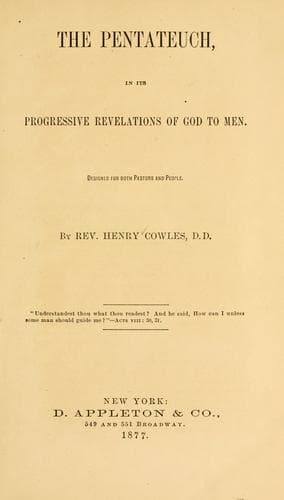
The Pentateuch, in Its Progressive Revelations of God to MenCowles, Henry
Religion
The Pentateuch, in Its Progressive Revelations of God to Men
Cowles, Henry
Bible. Pentateuch -- Criticism, interpretation, etc.
These revelations of himself stand forth in sunlight throughout this
Mosaic code. They are a glorious advance upon all that the world had
seen before. The true mission of civil law is brought out here with
great fullness; for it seems to be every-where assumed that if laws
protect and befriend the poor, they protect and befriend _all_. If the
spirit of law faithfully guards their interests, it can not well fail
to guard all interests that need the guardianship of human legislation.
It is a priceless boon to the race to have these ideas so beautifully
set forth and so substantially embodied in a code of laws fresh from
the hand and from the heart of the Infinite Father.
CHAPTER XIX.
THE RELIGIOUS SYSTEM OF THE HEBREWS.
THIS system contemplates as its ultimate end the obedience, homage,
and worship due from men to God. As a prime means toward this end, it
prescribes modes and forms of worship. It proposes to bring God near
to men and men near to God; and for this purpose would cultivate in men
the spirit of penitence and of faith――impressing them with a sense of
their sins and suggesting to them how sin may be forgiven; and how, on
the basis of God’s own provision for pardon, he can accept the humble,
reverent worship of his people.――――These fundamental ideas respecting
the sinner’s acceptance with God, the system now before us sought
especially to develop by means of visible symbols――these symbols
constituting the very elaborate and minutely described _religious
system of the Hebrews_.――――This system, having long since “waxed old
and vanished away” is no longer in practice, and therefore can not be
useful as a rule of present duty, but is useful for the light it throws
on the great and fundamental questions――How shall man――a sinner――become
just before God? Is an atonement necessary? What are the fundamental
ideas of “atonement”? How were they developed in the Mosaic system, and
what light does this development bring to the atonement presented to
view in the New Testament?
With superlative wisdom God began to give lessons on this great
subject very early in the history of our race. It was wise to give
such lessons long and carefully before the Great Atoning Sacrifice
came in human flesh. It was also wise to give them largely by visible
illustrations――by the aid of a system having so much of the external
and the visible that minds not disciplined to abstract thought might
see the truth and feel its power by means of sensible manifestations.
Public-domain text, read in full here on John Shaqi.
Reviews
Reviews
No reviews yet
Be the first to share your thoughts on this work.
Elsewhere in the archive
Join the Discussion
Join the discussion
Sign in to leave a comment or review.
Sign InorCreate an account