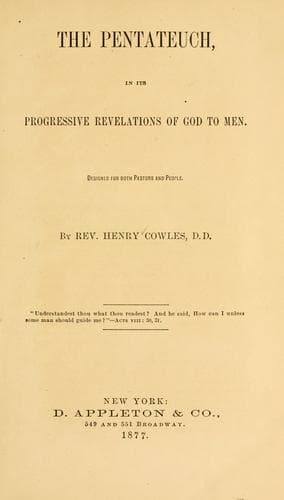
The Pentateuch, in Its Progressive Revelations of God to MenCowles, Henry
Religion
The Pentateuch, in Its Progressive Revelations of God to Men
Cowles, Henry
Bible. Pentateuch -- Criticism, interpretation, etc.
The reader will now see readily the purpose of the ensuing examination
of this religious system. It is not for historic curiosity――in which
case we might select points amusing or strange or sensational; it is
not to guide the worshiper (as Moses sought to do) in the minutest
details of the system that he might make no mistake in obeying it:――but
it is to gather as best we may its designed moral impression, to study
its underlying assumptions, and evolve its true doctrine in regard
to the great question of the sinner’s acceptance before a holy and
righteous God.
* * * * *
Briefly and comprehensively we may classify the leading features of
this system viewed externally, on this wise:
I. _Its prescribed sacrifices and offerings._
II. _Its stated times and seasons of worship._
III. _Its sacred edifices and apparatus for worship._
IV. _The religious orders――classes designated for sacred service._
I. The sacrifices and offerings of this system may be classified
variously:――――_e. g._ (1.) Bloody, or not bloody:――terms which will be
readily understood. The former were slain animals, a portion of whose
blood was sprinkled. The latter included offerings of flour, oil, wine,
etc.――――Or (2.) Some were specially required: others were voluntary or
free-will offerings.――――(3.) They may be classified with reference to
the times and seasons when they were to be made; some being daily, as
the morning and evening sacrifice; others for the Sabbath; others for
the new moons; others on occasion of the three great yearly festivals;
and, among the most useful for its suggestive import, those of the
great day of atonement.――――(4.) Or we might classify them under
the somewhat distinctive names given them in the law, of which we
find a large number. We have (a.) The generic word sacrifice [Heb.
Zebah]――a word which implies slaying, taking life:――――(b.) Another
quite generic term, “offering,” which is used to translate several
Hebrew words, and of course with very considerable latitude of
meaning:――――(c.) “Burnt-offering”――[which is the quite constant
translation of the Heb. “Olah”] signifying what _goes up upon the
altar_ and is consumed there. The phrase “whole burnt-offering” gives
according to the Hebrew, the sense of _completeness_――the whole of
the animal being burned on the altar:――――(d.) “Sin-offering”――in
Hebrew, one of the most common words for _sin_――[hatta]. Paul’s
use of the corresponding Greek word (2 Cor. 5: 21) follows
this usage of the word for sin: “God hath made him to be sin”
[a sin-offering] “for us who knew no sin,” etc.:――――(e.) “Trespass
offering”;――which is another of the Hebrew words for sin, offense
[“asham”]:――――(f.) “Meat-offering”; some variety of food or drink
other than flesh:――――(g.) “Peace-offering”――which seems closely related
to the “thank-offering,” being an expression of gratitude to God; the
animal sacrificed being in large part eaten socially by the offerer and
Public-domain text, read in full here on John Shaqi.
Reviews
Reviews
No reviews yet
Be the first to share your thoughts on this work.
Elsewhere in the archive
Join the Discussion
Join the discussion
Sign in to leave a comment or review.
Sign InorCreate an account