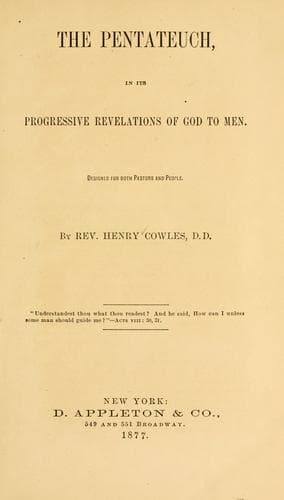
The Pentateuch, in Its Progressive Revelations of God to MenCowles, Henry
Religion
The Pentateuch, in Its Progressive Revelations of God to Men
Cowles, Henry
Bible. Pentateuch -- Criticism, interpretation, etc.
The careful reader of those portions of Exodus, Leviticus, and Numbers
which give the plan of the tabernacle, the ritual of the priests and
Levites and the minute detail of numerous sacrifices and offerings and
purifications, will not need the suggestion that in many respects the
interest and the value of these details have mostly passed away. Of
prime importance in that age; vital to the proper construction of the
tabernacle; vital to the due consecration of priest and Levite and to
their instruction in duty; entirely essential to the ends of a ritual
system which was to be the religious law of a great people――they were
all in place then and were indispensable; but in most respects this
interest and value have long since ceased. Whereas in the time of Moses
not one word of this minute detail was superfluous, not one point could
be safely omitted; now, it may be passed over with only brief notice.
Few will care to read all its particulars.
Yet two points deserve remark:
1. That this very minuteness of detail is the strongest evidence of the
genuineness and antiquity of these books. They were certainly written
at the time of the events they record. They never could have been
gotten up in any age subsequent to the events. The specifications for
the tabernacle and for all its furniture had a purpose then; but could
have had no purpose to justify such minuteness after the construction
was finished. It would be the supremest folly to forge such documents
ages after the events had passed. No man in his senses ever attempts
such a forgery. Men never submit to such labor without an object;
and the case precludes the possibility of any object _after_ the tent
was built and after the ritual was fully understood and wrought into
established usage.
2. While these minute details neither require nor reward particular
investigation in our day, yet taken in whole _they are pregnant with
great moral lessons for all time_.
(1.) There was a perpetual inculcation of cleanliness, external purity;
and the most careful avoidance of whatever was defiling. The ceremonial
washings and cleansings, the removal from the camp, or as the case
may be, the seclusion from the court of the tabernacle for a term
of purification, occur frequently. By a natural law of mind, sin is
associated with uncleanness; crime is defiling. Hence, with almost
infinite pains the Lord was impressing upon his people the great idea
that their God who deigned to dwell among them “was of purer eyes than
to behold iniquity.” He could not abide with them save as they kept
themselves clean and pure.
Public-domain text, read in full here on John Shaqi.
Reviews
Reviews
No reviews yet
Be the first to share your thoughts on this work.
Elsewhere in the archive
Join the Discussion
Join the discussion
Sign in to leave a comment or review.
Sign InorCreate an account