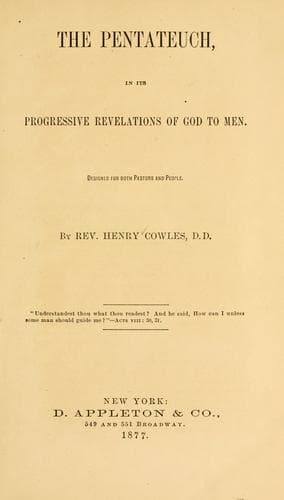
The Pentateuch, in Its Progressive Revelations of God to MenCowles, Henry
Religion
The Pentateuch, in Its Progressive Revelations of God to Men
Cowles, Henry
Bible. Pentateuch -- Criticism, interpretation, etc.
(2.) On every hand we note the most solemn inculcation of care,
thoughtfulness, consideration, especially in their religious worship,
and the most impressive warnings against a rash and inconsiderate
spirit. Hence wine was forbidden to the priests when about to go to the
altar (Lev. 10: 8–11). It seemed that God could have no patience with
the thoughtless and irreverent. At whatever cost, the fear of the Lord
must be impressed upon the people――else all effort for their religious
culture would be vain.
(3.) Their great thanksgiving festivals; their numerous thank-offerings;
their vows; their required tithes――all concur in this one idea――the
recognition of God as the Giver of all blessings, their great personal
and national Benefactor. No pains was spared to impress and enforce
this great truth. The long course of God’s redeeming mercies toward
their nation; the rescue from Egyptian bondage; the miraculous supplies
of bread and water forty years in the desert; the gift of the goodly
land of Canaan;――these were the staple facts of their history which God
sought to engrave upon the national heart and to work into the living
thought of the thousands of Israel. By every hopeful appliance their
religious system was shaped to keep alive and intensify these feelings.
(4.) More important than all the rest were the great moral lessons
set forth _by the perpetual presence of atoning blood_. The Israelites
were never allowed to forget that they were sinners, and that their
approach to God must always be through the blood of atonement. No
day might begin, no day might close, without the shedding of animal
blood――the sacrifice of an innocent animal’s life. The great days
were great because of the multiplication of these sacrifices――evermore
distinguished and memorable for the rivers of blood that flowed; for
the struggles and throes of the dying; for the sprinkling of blood,
_blood_, BLOOD, all round about the hallowed altar, toward the unseen
Presence within the most holy place, and upon the assembled hosts of
Israel.――――It may cost us a few moments’ effort to reproduce those
scenes before our mind’s eye so as to take in their full significance;
but this effort to comprehend that ancient ritual would bring its
reward. What a demonstration it would be in proof that “without
the shedding of blood there is no remission”! that God never looks
propitiously on guilty sinners save through the bleeding sacrifice of
his crucified Son! As bearing upon the great questions――the _fact_ and
the _nature_ of the atonement――this bloody ritual has a most vital and
impressive significance. No questions of deeper and more vital import
can ever arise than such as these: Was the death of Christ expiatory?
Was his blood shed for the sins of men? Did he lay down his life,
an innocent victim, that the guilty sinners who place their hands
upon his sacred head and there confess their sins may live and never
die? In a word, was his death foreshadowed and its true significance
Public-domain text, read in full here on John Shaqi.
Reviews
Reviews
No reviews yet
Be the first to share your thoughts on this work.
Elsewhere in the archive
Join the Discussion
Join the discussion
Sign in to leave a comment or review.
Sign InorCreate an account