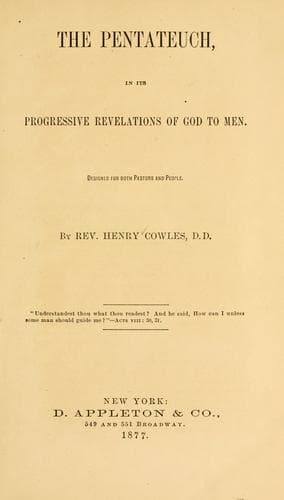
The Pentateuch, in Its Progressive Revelations of God to MenCowles, Henry
Religion
The Pentateuch, in Its Progressive Revelations of God to Men
Cowles, Henry
Bible. Pentateuch -- Criticism, interpretation, etc.
is _from God himself_ and _from God alone_. The original gift of it is
his prerogative and the secret thereof is for evermore with him.
8. In the passage――“Let us make man in our image, after our likeness”
(v. 26) there are two special points to be considered:――(a.) In _what
sense_ is man made in the image of God? (b.) The explanation of the
plural pronouns, “_us_” and “_our_”――“Let _us_ make man in _our_ image.”
(a.) Inasmuch as God is a spirit and never to be thought of as having
a corporeal nature――material, tangible to our bodily senses, we are
at once shut off from all reference to man’s physical, corporeal
nature and shut up to his spiritual nature to find in it the points
of this resemblance. Consequently man is made in God’s image as being
gifted like his Maker with intelligence and with capacities for moral
action――beyond comparison the noblest possible elements of being. He
has the sense of moral obligation and the voluntary powers requisite
to fulfill such obligation. He can find his supreme joy in voluntarily
seeking the good of others, even of all other sentient beings, and
in laboring even to the extent of self-sacrifice to promote their
welfare. This is the pre-eminent perfection of God――the very point
ultimately in which man is made in his image, and capable of becoming
more and more Godlike, forever approximating toward his holiness and
blessedness.――――His intellectual powers are only the servants of these
highest and noblest activities of his being.――――(b.) The use of the
plural pronouns――“Let _us_ make, in _our_ image”――has been accounted
for variously. Some would make this plural intensive, corresponding
to the emphatic plural in Hebrew nouns. But there seems to be no
real analogy in the two cases.――――Some make it the plural of dignity
(“pluralis excellentiae”), as an oriental monarch puts forth his edict,
saying “we,” not I. But the great simplicity of this whole narrative
goes against this explanation. Moreover, this usage, so far as it
appears in literature, sacred or profane, is later by many ages than
Moses. Besides, there is no apparent reason why God should assume more
dignity in saying――“Let us make man,” than in saying, Let us make light,
or the sun in the heavens. Indeed, the form of the divine behest――“Let
there be light,” seems to our ideas the more sublime and the more
expressive of God’s supreme dignity.――――I see no explanation of this
plural that is at all satisfactory save that which assumes a reference
to the persons of the Trinity. As one reason for such reference it
may be suggested as certainly not improbable――that the idea of man,
God’s chief work in creation, was coupled with his future history
(all present to the divine mind)――as fallen, yet also as redeemed, and
specially as redeemed _by means of the incarnation of the Son of God in
human flesh_. Supposing this incarnation present to the divine thought,
the significance of this plural would be――Let us proceed to make in our
Public-domain text, read in full here on John Shaqi.
Reviews
Reviews
No reviews yet
Be the first to share your thoughts on this work.
Join the Discussion
Join the discussion
Sign in to leave a comment or review.
Sign InorCreate an account