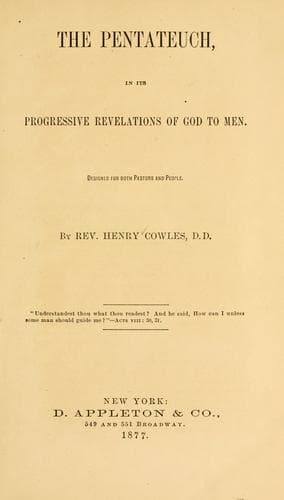
The Pentateuch, in Its Progressive Revelations of God to MenCowles, Henry
Religion
The Pentateuch, in Its Progressive Revelations of God to Men
Cowles, Henry
Bible. Pentateuch -- Criticism, interpretation, etc.
own image this wonderful being whose nature the eternal Son shall one
day assume――this man who is to bear relations to us so extraordinary,
so wonderful before the angels, so signal before all created minds,
so glorious in its results to the whole moral universe! Have not
_we_――Father, Son and Holy Ghost――a most surpassing interest in the
creation of this being, man!
9. _The relation of Gen. 2: 4–25 to Gen. 1._
Here are two points of some importance to be considered.
(1.) Are the two passages by the same author?
(2.) Do they both speak of the creation of the same first man, _i. e._
the same Adam, or is the Adam of Gen. 2 another and different first
man, brought into being long subsequent to him of Gen. 1: 26–28?
(1.) That the two passages are from different authors has been
maintained on the following grounds.――――(a.) That v. 4――“These are the
generations[8] of the heavens and the earth”――appears like the heading
of a new and distinct portion of history.――――But nothing forbids
that it should be the heading of a new section or chapter of the same
continuous history by the same author, resuming his subject with only
a very comprehensive allusion to the great facts of creation which he
had given in chap. 1, as fully as his plan required. This done he may
proceed to a more full account of the creation of man and the events
of his early history.――――(b.) That the account here differs somewhat
from that in Gen. 1, _e. g._ as to the creation of man, and yet more
especially, the creation of woman.――――But these differences are not
♦discrepancies and are fully accounted for by the scope and design of
this portion, viz. to give the history of the first man and woman in
much more detail.――――(c.) But especially this diversity of authors has
been argued from the different names of God which appear in these two
passages. In chap. 1 and 2: 1–3, the name is simply and exclusively
God (Elohim). In chap. 2: 4–25 and in chap. 3, the name is “the Lord
God” (Jehovah Elohim).――――This difference is indeed a palpable fact,
and has been the theme of an indefinite amount of critical speculation
based for the most part on the utterly groundless assumption that the
same author can not be supposed to have used both these names for God.
Those critics (mostly German) who have flooded their literature with
disquisitions on this subject assume in the outset that none but a
“Jehovist” ever used the name Jehovah, and none but an “Elohist,”
the name Elohim, it being in their view impossible or at least absurd
that the same author should use sometimes one of these names and
sometimes the other――which assumption seems to me supremely arbitrary,
irrational, and uncritical. Authors now use at their option the various
names for God, either for the mere sake of variety, or because in some
connections one seems more euphonious or more significant than another.
Why may not an equal license of choice be accorded to Hebrew writers?
Public-domain text, read in full here on John Shaqi.
Reviews
Reviews
No reviews yet
Be the first to share your thoughts on this work.
Join the Discussion
Join the discussion
Sign in to leave a comment or review.
Sign InorCreate an account