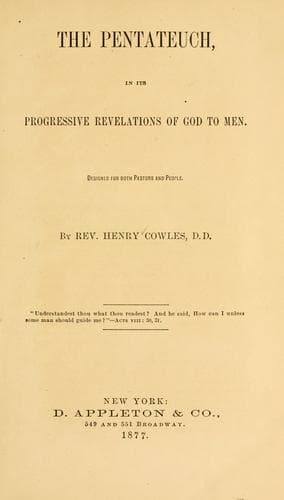
The Pentateuch, in Its Progressive Revelations of God to MenCowles, Henry
Religion
The Pentateuch, in Its Progressive Revelations of God to Men
Cowles, Henry
Bible. Pentateuch -- Criticism, interpretation, etc.
1. _The high antiquity_ claimed for man is fitly the first question in
order. Here the evidence comes and of necessity must come
(1.) From _traces of man_ upon the crust of the earth, _i. e._ in the
rock-strata, the drift-deposits, or in caves and lake-dwellings, or in
monuments of human labor and skill:
And (2.) from the traditions of the most ancient nations and the high
antiquity of their existence, civilization, and monuments.
Under the first head the traces are either
(A.) _Remains of the human skeleton_; or
(B.) _Remains of man’s work and of his tools._
(A.) As to the _remains of the human skeleton_.
By universal admission these remains are not found in the rocks that
bear in abundance the fossil vegetables of the third great epoch of
creation; nor in those yet higher strata that contain the oldest forms
of animal life whose home is in the waters; nor is man found with the
reptiles, say of the fifth day of creation; nor indeed until we come to
deposits of the most recent date, of a kind at least similar to those
which are known to be forming within the historic age of man.
From these admitted facts I make this special point, viz. that if man
had lived on the earth contemporary with the oldest animal species,
we ought to find not merely one skeleton or half a skeleton buried
along-side of myriads of fossil sea-shells and fishes, but a fair show
of specimens, so many at least as to leave no question as to his being
a joint occupant with them of the earth as it then was. One or two,
or even a dozen skeletons, gathered from every explored portion of the
earth’s surface, are too few for the base of a theory like this because
such scattered cases, in number so meager, are always subject, more or
less, to abatement from the following possibilities:
(a.) The human family in all ages have buried their dead, and often,
during the earlier ages, in rock-hewn sepulchers or in natural caves;
(b.) In all ages of the world men have been liable to fall into
rock-fissures and ravines and to die there; and to leave their
skeletons to become fossil there, particularly in calcareous and
similar rocks where decomposition or solution in water and new deposits
are in progress;
(c.) Men have been wont to frequent caves for shelter, for safety
in war or from persecution, and consequently might leave their bones
there; or
(d.) Their bones may have been dragged into caverns by flesh-eating
animals or borne into strange positions by underground currents of
water; or again,
(e.) Since the historic Adam, drift deposits have in some circumstances
been forming under water, in which waters men have been liable to be
drowned and their skeletons to become imbedded in those deposits.
Changes of elevation may bring such deposits to view.
Such possibilities must practically nullify confidence in the proof
of man’s high antiquity from his bones so long as the specimens are so
exceedingly few and even these few found only quite near the surface.
Public-domain text, read in full here on John Shaqi.
Reviews
Reviews
No reviews yet
Be the first to share your thoughts on this work.
Join the Discussion
Join the discussion
Sign in to leave a comment or review.
Sign InorCreate an account