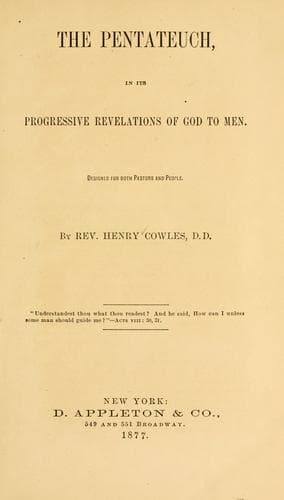
The Pentateuch, in Its Progressive Revelations of God to MenCowles, Henry
Religion
The Pentateuch, in Its Progressive Revelations of God to Men
Cowles, Henry
Bible. Pentateuch -- Criticism, interpretation, etc.
Let it be premised in the outset that this distinction of race is
one of _variety_ and not of _species_. It sits upon the surface and
does not penetrate to the inner nature. All these races have the same
anatomical structure; the same physical organs; and what is far more,
the same intellectual and moral nature. Every-where they exhibit the
common effects of the fall of Adam; the same depravity of moral nature;
the same common need of redemption by Christ.――――These are cardinal
traits and tests. What is the color of the skin compared with the stamp
of God’s image upon the very nature itself?
That these races intermingle and cross indefinitely is sufficient
proof that they are only _varieties_, and by no means distinct
_species_.――――Yet this of itself does not prove that all men have
descended from one first man――Adam. For the Lord had power to create
five or ten Adams, each the head-center of as many distinct races,
yet all, of the one species, _man_. So far therefore as respects the
creative power of God or the constitution of man, this is an open
question: _What then are the facts_?
1. The Scriptures imply with the strongest form of implication that
the Adam of Genesis is the father――the one only father――of the whole
human race. The narrative of the creation; of the fall; and of the
first promise of redemption――all imply this. Paul implies it in those
passages in which he compares the ruin of the race through the one
man Adam with the salvation provided for the race through the greater
second _Man_, Jesus Christ. The strong passages are Rom. 5: 12–19 and
1 Cor. 15: 21, 22.
2. The diversities of race may be accounted for as produced by either
or both of two causes; (a.) Climatic influences; (b.) Sporadic,
abnormal peculiarities, appearing suddenly, and perpetuating themselves
by inheritance.
3. The geographical distribution of the race from one head-center,
Adam, is certainly possible. There is some reason to suppose that the
relative position of the seas, oceans, and continents at their points
of nearest approach may have been different in the earlier ages from
the present.
4. The proofs of a common language from which all known human languages
have been derived conspire to sustain the common origin of all the
human family.
This list of proofs might be extended and the argument from these
points greatly expanded.
On the subordinate question whether Noah was the common ancestor of all
the races living since his day, the answer turns mainly on the point of
the universality of the deluge; or rather, on this precise point――Did
the deluge destroy all the living men except those saved with Noah in
the ark?
This question will be considered in its place.
CHAPTER V.
THE SABBATH.
Public-domain text, read in full here on John Shaqi.
Reviews
Reviews
No reviews yet
Be the first to share your thoughts on this work.
Elsewhere in the archive
Join the Discussion
Join the discussion
Sign in to leave a comment or review.
Sign InorCreate an account