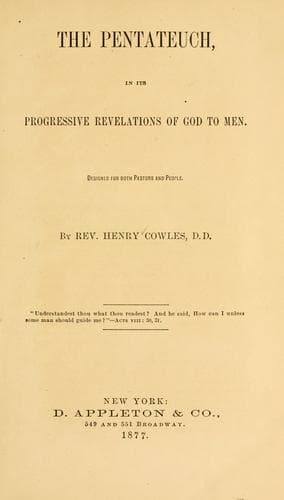
The Pentateuch, in Its Progressive Revelations of God to MenCowles, Henry
Religion
The Pentateuch, in Its Progressive Revelations of God to Men
Cowles, Henry
Bible. Pentateuch -- Criticism, interpretation, etc.
IT has been already suggested that the division of the creative
work into six days rather than into five or ten or any other number,
contemplated the weekly Sabbath and was designed to connect this
Sabbath for man with God’s rest from this creative work so that the
Sabbath should be at once a memorial of the creation and should bear in
itself the force of God’s example in his relative periods of labor and
of rest. God created this beautiful earth for man’s abode, and man to
dwell upon it; therefore let man remember his Great Creator and Father,
thoughtfully contemplating his works, admiring and adoring, worshiping
and serving the Glorious Author of both his being and his blessings.
God wrought six days and rested one; so let man throughout all the
ages of earthly time. Such is the relation of the Sabbath to God and
to man.――――Note therefore
1. _God ordained and enjoined it._ It is precisely a divine
institution――not man-made but heaven-born; an outgrowth of God’s wisdom
and love for his offspring man――for that one of all his creatures whom
only God “made in his own image.” “God blessed the seventh day and
sanctified it; because that in it he had rested from all his work which
God created and made” (Gen. 2: 3). “Blessed and sanctified”――not _as
to himself_ but _as to man_; _i. e._ not to make the day a blessing to
himself but a blessing to man; not to make the day holy _to himself_
but holy _as to man_. It was a day for man to keep holy and a day
laden with blessings for man on condition of his sacredly observing
it in its true spirit and intent.――――In accord with this view are our
Savior’s words (Mk. 2: 27), “The Sabbath was made for man”――to become a
blessing for man, one of the great and sure channels of mercy from the
Great Father to his obedient children. Thus the Sabbath was instituted
for man when the race existed in Adam and Eve alone――one of the
institutions revealed from God and enjoined in Eden――good for man
before his fall, and surely not less needful to the race fallen than
to the race sinless. Let it be distinctly considered that this Sabbath
was instituted with no limitations of time or race or nation――not for
Eden alone; not for the race before their fall only――to become defunct
when man began to sin; not for the Jews alone to be only a Jewish
national observance and to become obsolete when the ceremonials of
Judaism “waxed old and vanished away.” It was indeed prescribed anew
to the Hebrew nation and enforced with new sanctions, especially by his
obligations to his covenant-keeping God for national deliverance from
Egyptian bondage; but this weighs not a feather against the doctrine
that the Sabbath was made _for man_. While the Sabbath obligation,
thus heightened by new mercies, might be said to become more sacred and
obligatory upon the Jewish nation, this fact could by no means make the
day less sacred to the Gentiles of every land and of all time.
Public-domain text, read in full here on John Shaqi.
Reviews
Reviews
No reviews yet
Be the first to share your thoughts on this work.
Elsewhere in the archive
Join the Discussion
Join the discussion
Sign in to leave a comment or review.
Sign InorCreate an account