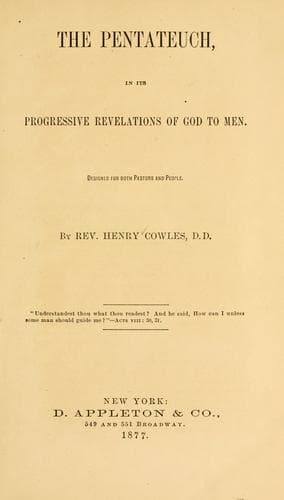
The Pentateuch, in Its Progressive Revelations of God to MenCowles, Henry
Religion
The Pentateuch, in Its Progressive Revelations of God to Men
Cowles, Henry
Bible. Pentateuch -- Criticism, interpretation, etc.
CHAPTER XX.
HISTORIC EVENTS OF HEBREW HISTORY FROM SINAI TO THE JORDAN, 342;
The golden calf, 342;
The intercession of Moses, 343;
The Lord reveals his name and glory, 346;
Incidents connected with this idol-worship, 350;
Lessons from Moses on prayer, 353;
Taberah and Kibroth-hataavah, 354;
Miriam and Aaron envious of Moses, 355;
Kadesh-barnea and the unbelieving spies, 356;
Rebellion of Korah and his company, 360;
The fiery serpent and the brazen one, 363;
Balak and Balaam, 364;
Balaam’s prophecies, 367;
His prayer, 368.
CHAPTER XXI.
ON THE LAST FOUR BOOKS OF THE PENTATEUCH, 375;
Their _method_ and _subject-matter_, 375;
Leviticus, 376;
Numbers, 376;
Deuteronomy, 377;
Deut. 12–26, 378;
The prophet like Moses, 380;
The blessings and the curses, 383;
The last words of Moses, 384;
The Song of Moses, 386;
Moses blesses the tribes, Deut. 33, 394;
Death and character of Moses, 401;
The Mosaic system and the future life, 403;
Progressive developments of truth and of God, 412.
Advertisements, 415
INTRODUCTION.
THE REVELATIONS OF GOD TO MEN PROGRESSIVE.
IT is supposable that God might have made his entire written revelation
of himself to men _at once_, through one inspired prophet and one only;
in one definite locality (Eden or Jerusalem), and all brought within a
twelve-month. But he did not deem this the wisest way. He preferred to
speak at considerable intervals of time――through a long succession of
“holy men of old;” “at sundry times and in diverse manners” (Heb. i: 1).
Among the choice results of this progressive method we may name the
following: (1.) That by means of it God made large and admirable use of
_history_. This was revealing himself to men, not simply by his _words_
but by his _works_. In ways which men could not well mistake, he was
thus able to manifest himself as the God of nations; also as the God
of families; and not least, as the God of individual men. It was vital
to human welfare that he should place himself before men as being
not a heathen Brumha, sunk in unconscious sleep for ages, but as the
All-seeing, ever-active One, exercising a real government over men,
ruling in equity and yet with loving-kindness; ever present amid all
their activities and impressing himself upon the thought and the heart
of the race. In this line of policy how admirably did he give promises
to his servants to inspire their faith in himself; then prove that
faith through years and ages of trial and delay; but at last confirm
his word by its signal fulfillment! By what other method could He so
effectually reveal himself as a _personal God_――the personal Friend
of his trustful children――evermore worthy of their supreme confidence,
whether they could or could not see at once all the reasons of his
ways?
Public-domain text, read in full here on John Shaqi.
Reviews
Reviews
No reviews yet
Be the first to share your thoughts on this work.
Join the Discussion
Join the discussion
Sign in to leave a comment or review.
Sign InorCreate an account