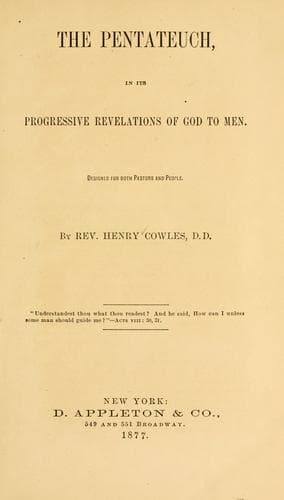
The Pentateuch, in Its Progressive Revelations of God to MenCowles, Henry
Religion
The Pentateuch, in Its Progressive Revelations of God to Men
Cowles, Henry
Bible. Pentateuch -- Criticism, interpretation, etc.
2. As sustaining scripturally this argument for the divine appointment
of the Sabbath for the race of mankind, let it be noted that the
seven-day division of time is unquestionably traceable to this primeval
institution. It did not originate in the revolution of the earth on
its axis which makes the common day, nor in its revolution in its orbit
round the sun which makes the year, nor in the changes of the moon
which mark off lunar months. It is an abnormal――we might say unnatural
division of time――one which comes not of nature but from a source above
nature――from God directly and from God alone.
Historically we find this seventh-day period in existence during the
flood. Noah observed it and sent out the raven and the dove after
seven-day intervals of time.――――It becomes most distinctly apparent
in the recorded history of the manna (Ex. 16: 22–30). By the natural
law of the manna, each next day’s supply was distilled each night
upon the adjacent grounds, ready for the labor of gathering it in
the early morning. This would normally make labor a necessity for
their subsistence _every day_, leaving them no Sabbath. Therefore God
arrested the normal law at the Sabbath point and provided a double
supply on the morning next preceding, giving none on the morning of the
Sabbath. Moreover by another special provision, this double supply was
kept two days from putrefaction――in this case only, so that it sufficed
perfectly for their wants till the Sabbath was past. Some of the people,
oblivious of the Sabbath, “went out on the seventh day to gather, and
found none. And the Lord said unto Moses, How long refuse ye to keep
my commandments and my laws? See, for that the Lord hath given you
the Sabbath, therefore he giveth you on the sixth day the bread of two
days; abide ye every man in his place; let no man go out of his place
on the seventh day” (Ex. 16: 27–30). Most decisively therefore does
this narrative assume that the Sabbath was not then a new institution
but an old one. This scene and these words, be it remembered, were
before (not after) the giving of the ten commandments from Sinai.
Public-domain text, read in full here on John Shaqi.
Reviews
Reviews
No reviews yet
Be the first to share your thoughts on this work.
Elsewhere in the archive
Join the Discussion
Join the discussion
Sign in to leave a comment or review.
Sign InorCreate an account