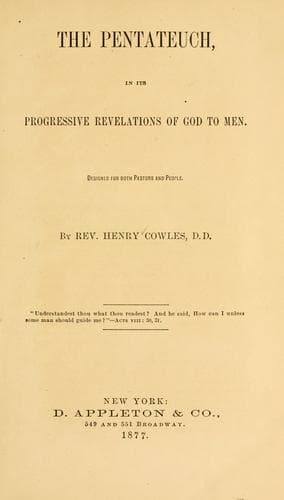
The Pentateuch, in Its Progressive Revelations of God to MenCowles, Henry
Religion
The Pentateuch, in Its Progressive Revelations of God to Men
Cowles, Henry
Bible. Pentateuch -- Criticism, interpretation, etc.
To the same purport is the form of the fourth commandment; “_Remember_
the Sabbath day to keep it holy.” The Lord does not say――I now
introduce a new and special precept. His words, “Remember” etc. do not
imply this but imply the very opposite of this. So also do the reasons
assigned; viz. God’s creative work finished in six days with rest on
the seventh. If this were a reason for the Sabbath, it was certainly
good for Adam in Eden and for all of Adam’s children to the end of the
world. Corresponding to this we may note that in this fourth command
God does not say――I appoint each seventh day for a sign between me and
thee and a memorial of your national deliverance from Egyptian bondage
(as many have maintained――to make out that the Sabbath was nothing but
a Jewish institution) but this is not the form in which the Sabbath
stands in the immortal decalogue. These points――a “sign” between the
Lord and Israel and a memorial of deliverance from Egypt, came in fitly
afterwards as a supplement――an appendix to this fourth command _in its
special relations_ to the children of Israel. See Ex. 31: 12–17 and
Ezek. 20: 12, 20, with my Notes on the passage in Ezekiel. But these
special and superadded relations of the Sabbath to the Hebrews can
not possibly in reason diminish the obligation of the original Sabbath
ordained for man as a race in Eden.
4. To complete the argument for a perpetual Sabbath, it is only needful
to add that our Lord re-endorsed it and gave it the whole weight of
his sanction for all future time; and in these several ways: (a.) By
re-endorsing the entire decalogue――“I am not come to destroy the law
but to fulfil” (Mat. 5: 17). The scope of the sermon on the mount――(of
which these words are a part) proves that his eye was on the great
moral law of ten commandments. Plainly he could not have spoken of the
Mosaic ceremonial law, and therefore must have spoken of that special
code of precepts of which the Sabbath was the fourth.――――(b.) He
endorsed the Sabbath as perpetual and universal by solemnly
declaring――“The Sabbath was made _for man_” (Mk. 2: 27).――――(c.) Also
by affirming it to be his own prerogative to enforce the Sabbath and to
set forth its spirit and expound its obligations. “Therefore,” because
the Sabbath was made for man, for all men of all time, “therefore,
the Son of man is Lord also of the Sabbath” (Mk. 2: 28). It was in
order to relieve the law of the Sabbath (as then currently expounded)
from burdensome, excessive and injurious constructions which human
nature could not bear and which were alien from its true spirit, that
our Lord confronted the traditions of the Scribes and Pharisees and
sought to place this great institution upon its true and eternal
basis.――――(d.) Finally as showing historically that our Lord had never
a thought of terminating the obligation of the Sabbath at his death but
designed its obligation to be perpetual, we have this very incidental
Public-domain text, read in full here on John Shaqi.
Reviews
Reviews
No reviews yet
Be the first to share your thoughts on this work.
Elsewhere in the archive
Join the Discussion
Join the discussion
Sign in to leave a comment or review.
Sign InorCreate an account