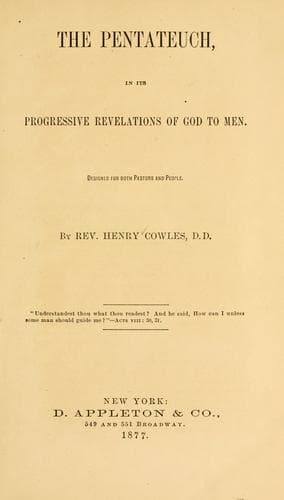
The Pentateuch, in Its Progressive Revelations of God to MenCowles, Henry
Religion
The Pentateuch, in Its Progressive Revelations of God to Men
Cowles, Henry
Bible. Pentateuch -- Criticism, interpretation, etc.
4. Other points in this narrative are recognized in the Scriptures
as historic and not merely symbolic. Paul wrote to Timothy (1 Tim.
2: 13–15): “For Adam was first formed, then Eve, and Adam was not
deceived; but the woman being deceived, was in the transgression.
Notwithstanding, she shall be saved in child-bearing,” etc.――all
referring very definitely to this narrative as fact and not merely
drapery illustrating some universal truth.――――To the same purport is
Paul in Rom. 5: 12, 19: “As by one man sin entered into the world and
death by sin.” “As by one man’s disobedience many were made sinners,”
etc. So also 1 Cor. 15: 21, 22.
5. The sin of the first pair stands in its appropriate historic place
here (not a merely symbolic place), being immediately connected with
the curse upon the serpent (and under him upon the devil); upon the
woman also, and the man and the ground; also with the expulsion from
Eden and man’s changed life, from the ease and the delights of Eden to
sweating labor upon a stubborn soil, in perpetual conflict with noxious
growths.――――These considerations suffice in my view to prove that this
narrative must be taken as simple history, and not as symbolic drapery
employed to set forth, not these specific events, but only the general
truth of human depravity.
II. _The Moral Trial._
Provision was made for this trial by one simple prohibition, forbidding
to them the fruit of one tree in the midst of the garden. Of all else
they might eat as they pleased. All they could need for subsistence
or enjoyment was freely permitted them; but the fruit of this one
tree they might not eat on pain of death. This was the test of their
obedience. This was to discipline their faith and their love toward
their divine Father. There the tree stood before their eyes in the
midst of the garden――every sight of it suggesting their Great Father’s
word――not to be eaten at all on penalty of death. Will they cheerfully
and even joyfully deny themselves so much for the love they bear their
Father? So long it shall be well with them. Every time they put down
the temptation to eat of it they will become stronger in their spirit
of obedience and more happy in God. It was a means of continual culture
in holiness, ever leading onward and upward into deeper communion with
God and more assured and joyous submission to his will, more strength
of purpose in obedience, more delight in whatever self-denial obedience
might involve. Surely it is not too much to say that they might make
this means of moral culture a priceless blessing to their souls. How
could paradise meet the greatest of all their wants――the want of their
new-born souls――without this one provision for proving and invigorating
their loving obedience to their God?
Public-domain text, read in full here on John Shaqi.
Reviews
Reviews
No reviews yet
Be the first to share your thoughts on this work.
Elsewhere in the archive
Join the Discussion
Join the discussion
Sign in to leave a comment or review.
Sign InorCreate an account