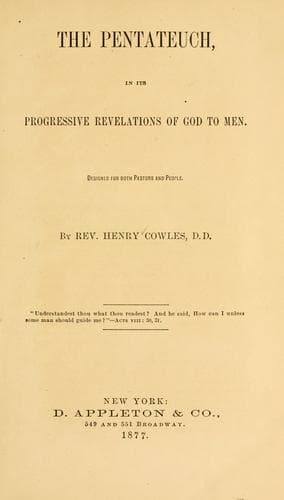
The Pentateuch, in Its Progressive Revelations of God to MenCowles, Henry
Religion
The Pentateuch, in Its Progressive Revelations of God to Men
Cowles, Henry
Bible. Pentateuch -- Criticism, interpretation, etc.
Need we then raise the question――_What was God’s purpose in this
prohibition?_ The answer is at hand――To accomplish precisely this
result; to give the first human pair a test of obedience which should
be naturally a means of moral culture and of growth in holiness.――――The
horrible thought――that God meant and sought to make them sin――how
can we say less of it than that it is born of Satan! For it assumes,
as Satan did in the garden, that God sought, not their good, but
their hurt; is not benevolent but malevolent! Our souls recoil from
this assumption. Doth not the Scriptures say truly (Jas. 1: 13),
“Neither tempteth he any man”? Never, for the purpose of drawing him
into sin!――――Is it replied:――God certainly knew they would eat that
forbidden fruit; the answer is, Undoubtedly he did; but this proves
nothing as to his purpose and aim in placing them under this moral
trial. If it be yet said――He might have made the trial so much less
that they would have borne it successfully: the proper answer is,
Who knows that? Who is wiser or more loving in such an emergency than
God?――――Consider also that while God knew they would fall, he also
knew that he could redeem the race through his Son, gloriously; and
so could make the wrath of both wicked men and devils subserve his
praise. We may account this to be his reason for subjecting the first
pair to a form of trial (every way good and wise in itself and well
designed)――although he foresaw they would fall before it. It was still
(as he saw the case through to its remotest end) better than any other
form of trial; better than no trial at all, supposing such a thing in
their case possible.
Thus may we vindicate God’s ways in this transaction. It was kind in
him to grant for their free use every other fruit in the garden――all
they could need. It was right that he should impose some test of their
obedience and love. Indeed it was a natural necessity of their moral
nature that this question of obeying God, always and every-where,
should come to issue. As surely as they were moral beings, capable of
knowing duty and of doing it, born into being with susceptibilities
to happiness which sometimes must be virtuously denied at the demand
of God and of the greater good, so surely they must meet this trial
sooner or later, in one form or another, until they become so strong
in their holy purpose, so fixed in the spirit of love and obedience
to God that temptation to sin is of course spurned away and duty is
done for evermore without a question. Moral trial, therefore, if not in
this precise form, yet in some analogous form, is the necessary means
of developing moral strength and confirmed holiness; is therefore the
natural pathway to the blessedness of heaven. Thus, with no wavering of
doubt, we may vindicate God’s ways toward man in this first great moral
trial brought on our race.
Public-domain text, read in full here on John Shaqi.
Reviews
Reviews
No reviews yet
Be the first to share your thoughts on this work.
Elsewhere in the archive
Join the Discussion
Join the discussion
Sign in to leave a comment or review.
Sign InorCreate an account