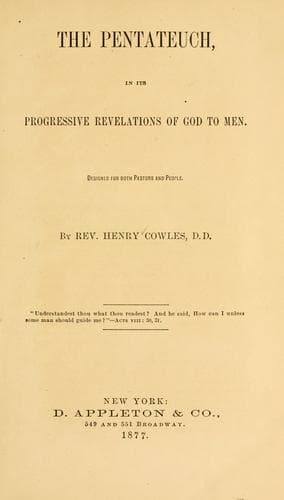
The Pentateuch, in Its Progressive Revelations of God to MenCowles, Henry
Religion
The Pentateuch, in Its Progressive Revelations of God to Men
Cowles, Henry
Bible. Pentateuch -- Criticism, interpretation, etc.
(2.) While on the one hand we may not limit the miraculous power of
the Almighty; on the other hand, it is not legitimate to assume an
expenditure of miraculous power indefinitely beyond what the occasion
demands.――――This objection is designed to apply, not specially to the
supply of water requisite to flood the whole earth at once, for there
is water enough in the oceans and seas to submerge the continents,
provided only that the ocean beds be temporarily uplifted and the
continents relatively depressed: but it does apply with great force to
the preservation of the living animals and plants of the whole world.
The narrative assumes that the deluge will destroy the land animals
and the fowls of the air unless they are protected in the ark. It
also gives us the dimensions of the ark, and leaves us to estimate
proximately how many could be saved alive in it. The narrative,
therefore, does not authorize us to resort to miracle for the
preservation of these animal races.――――Now it is entirely certain that
only an exceedingly small part of all the land animals, insects and
birds of the whole world were saved in the ark. Men versed in natural
science estimate the living species of vertebrate animals at 21,000;
of articulates, 300,000――numbers by far too great to be provided for
in Noah’s ark.――――Yet again: To a great extent the “fauna” (as they are
called)――the animal species of the several continents――differ widely
from each other. South America has its families, many of them unknown
to other continents; Australia has its special group, and Africa its
own. It is simply incredible that all or even the mass of these animals
came to Noah and were preserved in the ark. If they had been destroyed
by the flood, there should be traces of their sudden annihilation
in the drift of that flood, and geological research might trace
the introduction of new races by special creation to repeople those
continents. No such line of proofs for a universal deluge is found.
The absence of such traces of destruction and of new creation makes
it far more than probable that the flood was limited in extent and not
universal.
Still further it is urged against a universal deluge――and for aught
that appears conclusively――that volcanic cones exist――of Etna in Sicily
and of Auvergne in Southern France――which, being composed of loose
scoriæ and ashes, must have been washed away by any deluge that should
reach them. The cones of Etna are estimated to be 12,000 years old.
Public-domain text, read in full here on John Shaqi.
Reviews
Reviews
No reviews yet
Be the first to share your thoughts on this work.
Elsewhere in the archive
Join the Discussion
Join the discussion
Sign in to leave a comment or review.
Sign InorCreate an account