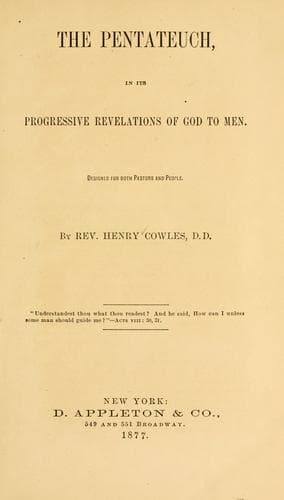
The Pentateuch, in Its Progressive Revelations of God to MenCowles, Henry
Religion
The Pentateuch, in Its Progressive Revelations of God to Men
Cowles, Henry
Bible. Pentateuch -- Criticism, interpretation, etc.
(3.) The apparently universal language of the narrative may be readily
explained as other similar language must be in the Scriptures, without
assuming a range of meaning beyond the writer’s personal knowledge. The
writer of this narrative (Gen. chaps. 6–9) speaks _as an eye-witness_,
especially of the great rain; of the ark borne up upon the waters; of
the surging back and forth of the billows, and of their covering “the
high hills under the whole heaven,” _i. e._ as far as the eye could
reach. The same style of universal language appears frequently in the
Scriptures, yet subject to limitations from the known nature of the
case; _e. g._ Deut. 2: 25: “This day will I begin to put the fear of
thee” [Israel] “upon the nations _that are under the whole heaven_;”
Acts 2: 5――“There were dwelling at Jerusalem, Jews, devout men, out _of
every nation under heaven_.” Mat. 3: 5: “Then went out to him Jerusalem,
and _all Judea_, and _all_ the region round about Jordan.”――――It is
in point to notice also that the word “_the earth_,” so frequently
used in this narrative, very often has the sense――_the land_. It should
manifestly have a meaning as broad when used of the extent of the
judgment as when used of the extent of the sin, and not necessarily any
more broad. Of the sin it is said repeatedly――“The _earth_ was corrupt
before God;” “the _earth_ was filled with violence.” Obviously this
same “_earth_,” to the same geographical extent and not apparently
any thing more, was destroyed by the flood. It may be noticed also
that the word “ground” [Heb. adamah] is used (Gen. 7: 23) as a synonym
for “earth”――“every living substance which was upon the face of the
_ground_”――but this carries with it no sense of universality as to this
globe.
There is every reason to suppose that at this time both the righteous
descendants of Seth and the wicked descendants of Cain were living in
the great basin of the Euphrates and the Tigris――with great probability
not reaching out beyond the area bounded by the Indian Ocean, the
Persian Gulf, the Caspian, Black, Mediterranean and Red Seas. This,
therefore, we may assume to have been the area submerged by this deluge,
and we have no occasion to look for its traces beyond these limits.
2. Whether the deluge destroyed all living men from the face of
the whole geographical earth except those in the ark, it is perhaps
impossible to decide with absolute certainty. If any were not reached,
they must have been such as had wandered early, far from their native
home, suppose into China or Africa, where neither the corruption which
became the moral cause of the deluge nor the deluge itself reached
them. The question is one of probabilities only, for we have no certain
knowledge on the subject and can not have. The probabilities are in my
view quite against the supposition.
_Traditions of a Great Deluge._
Public-domain text, read in full here on John Shaqi.
Reviews
Reviews
No reviews yet
Be the first to share your thoughts on this work.
Elsewhere in the archive
Join the Discussion
Join the discussion
Sign in to leave a comment or review.
Sign InorCreate an account