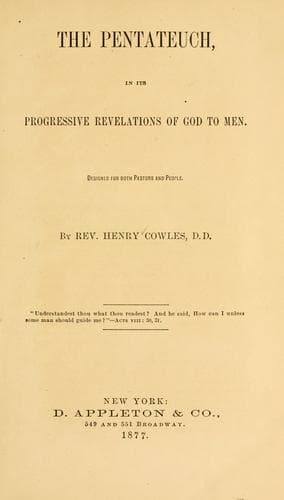
The Pentateuch, in Its Progressive Revelations of God to MenCowles, Henry
Religion
The Pentateuch, in Its Progressive Revelations of God to Men
Cowles, Henry
Bible. Pentateuch -- Criticism, interpretation, etc.
All the great nations of history have traditions more or less definite
of a vast deluge in the days of their fathers. As should be expected,
these traditions compared with the Bible record are variously modified,
corrupt we might say, mixed with fable, magnified as great stories
are wont to be in passing from lip to lip through many generations.
In general those are most pure which are found nearest the locality
of Eden and which were earliest committed to writing. Some authors
classify them into the _West Asiatic_, including the Babylonian, that
of the Sibylline books, the Phrygian, the Armenian, and the Syrian,
some of which are remarkably close to the truth. The _East Asiatic_,
including the Persian, the Chinese, and the Indian; the _Grecian_,
found in Plato, Pindar, Apollodorus, Plutarch, Lucian and Ovid; and
those of _peoples and tribes outside of the old world_――the Celts of
Northern Europe, the Mexicans, the Peruvians, the Indians of America
and the tribes upon the Pacific Islands. Lange remarks that the ethical
idea of the flood as a judgment upon men for their sins is every-where
apparent. The Chaldean traditions, brought down in the writings of
Berosus (wrote B. C. 260), are singularly minute and quite in harmony
with the scriptural account in its main outlines, some of which are as
follows:
Giving the name of Xisuthrus to the last of the primitive kings, it
sets forth that he was warned of the flood in a dream; was commanded
to write down all the sciences and inventions of mankind and preserve
them; to build a ship and save therein himself and his near friends,
and take in also animals with suitable food. After the flood had
somewhat subsided, he let fly a bird which came back; a second which
returned with slime on its foot; a third which never returned. Then
seeing land visible, he opened his vessel and came forth with his wife
and children; built an altar and offered sacrifice to the gods. They
found the country to be Armenia. Portions of the ark were long in
existence, sought for as amulets and charms.
The Chinese story may be taken as a sample of those more remote from
the locality of Noah. As given by the Jesuit, M. Martinius, the Chinese
date this great flood B. C. 4000; say that Fah-he, the reputed author
of Chinese civilization, escaped the flood, and together with his wife,
three sons and three daughters, repeopled the renovated world.
Dr. Gutzlaff communicated a paper to the Royal Asiatic Society (as
in their Journal xvi: 79) in which he stated that he saw in one of
the Buddhist temples in beautiful stucco the scene where Kwanyin, the
Goddess of Mercy, looks down from heaven upon the lonely Noah in his
ark amidst the raging waves of the deluge, with the dolphins swimming
around as his last means of safety and the dove with an olive-branch in
his beak flying toward the vessel. Nothing could exceed the beauty of
the execution.[24]
Public-domain text, read in full here on John Shaqi.
Reviews
Reviews
No reviews yet
Be the first to share your thoughts on this work.
Elsewhere in the archive
Join the Discussion
Join the discussion
Sign in to leave a comment or review.
Sign InorCreate an account