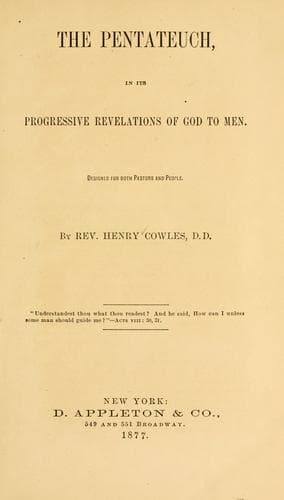
The Pentateuch, in Its Progressive Revelations of God to MenCowles, Henry
Religion
The Pentateuch, in Its Progressive Revelations of God to Men
Cowles, Henry
Bible. Pentateuch -- Criticism, interpretation, etc.
Those which are found among the ancient people of the Western
Continent――the Cherokees, Mexicans and Peruvians――have special interest
as proving that, remote as these tribes were from the locality of Noah,
they must have had a common origin and must have received this common
tradition of the flood from the valley of the Euphrates.
CHAPTER IX.
FROM THE FLOOD TO THE CALL OF ABRAHAM.
1. _The law against murder and its death-penalty._
When the waters of the great deluge had subsided and Noah and his
family found themselves once more upon the face of the solid earth――an
unpeopled solitude――that which we read in Gen. 9, was beautifully
in place:――“_And God blessed Noah and his sons._” So long imprisoned
in the ark; so long in the presence of this fearful visitation of
a righteous God upon a hopelessly corrupt generation, how naturally
must their view of human life take on a somber hue, and how refreshing
to be assured that the Great God was still their loving Father! “God
blessed them and said, ‘Be fruitful and multiply and replenish the
earth,’”――for God would have it filled again with living men. Moreover,
though few and feeble, they need not fear the violence of the animal
creation, for “the fear of you and the dread of you shall be upon every
beast of the earth; ... into your hand are they delivered.” Then by
special provision, apparently never made before, God sanctioned the use
of animal flesh for human food. Yet lest this sanction should make them
dangerously familiar with the shedding of blood, and tend to lesson the
sacredness of human life, God solemnly forbade the use of blood for
food, and then proceeded to ordain that human blood shed by ferocious
animals should be avenged with their life. Then follows special
legislation against murder by guilty human hands: “Whoso sheddeth man’s
blood, by man shall his blood be shed, for in the image of God made he
man.”――――That this is precept and not merely prophecy is so apparent
that argument in proof might seem almost an insult to the common
understanding of mankind. Yet the passage has been wrested in this way
from its obvious significance. It should be construed in harmony with
the scope of the context. Note therefore, that its close connection
with the use of animals for the food of man and with the “requiring”
of human blood shed by the violence of beasts compel us to find here
precept and not prediction. Still more does the historic place of this
precept, standing upon the ruins of the old world and in the presence
of the yet unwasted bones of thousands whose wickedness had culminated
in such recklessness of human life that “the earth was filled with
violence.” In the presence of such gigantic iniquity, grown up under
the experiment of pardoning and not punishing the crime of murder and
giving unrestrained license to bloody passion, it was pertinent to
lay a new and more effectual foundation for maintaining the peace of
Public-domain text, read in full here on John Shaqi.
Reviews
Reviews
No reviews yet
Be the first to share your thoughts on this work.
Elsewhere in the archive
Join the Discussion
Join the discussion
Sign in to leave a comment or review.
Sign InorCreate an account