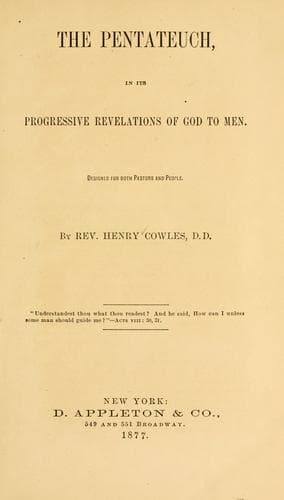
The Pentateuch, in Its Progressive Revelations of God to MenCowles, Henry
Religion
The Pentateuch, in Its Progressive Revelations of God to Men
Cowles, Henry
Bible. Pentateuch -- Criticism, interpretation, etc.
society and the sacredness of human life. The solemn lessons of the
past required, not a prediction of retributive vengeance under the
social law of self-preservation, but a divine precept demanding it and
enforcing it with its logical reason――that “God made man in his own
image.” You may take the life of the lower animals for no higher cause
than human sustenance――food for man’s wants;――but let no man put forth
his hand against the blood of man, for he bears the very “image of
God.”――――To make this new law the more solemnly impressive, man must
himself be the executioner of this divine behest――“_By man shall his
blood be shed._” Society itself must commit to some of its members this
solemn function and they must take the murderer’s life. Nothing less
can shield the life of man from bloody violence; nothing less will duly
honor God’s image in man.
* * * * *
2. _The prophecy of Noah._
In Gen. 9: 25–27 we have the first of those patriarchal utterances
of prophetic sort, in various strain――blessing and _not_ blessing――of
which several examples occur subsequently, as in the case of Jacob
(Gen. 49: 1–27); Moses (Deut. 33: 1–29). The form is thoroughly that
of Hebrew poetry――the brief parallelism of sentiment and language
being the prominent feature.――――The circumstances which called out
these prophetic words are given briefly in the narrative. Noah having
come forth from the ark soon commenced the culture of the vine and
experimented (unfortunately) in the free use of its wine. While he
lay overcome and personally exposed in his tent, his younger son Ham,
lost to all sense of filial duty, reported the sad spectacle. Shem and
Japheth, with filial pity and with the most delicate modesty, covered
his shame. When Noah awoke to consciousness and came to know what his
younger son had done unto him, he said, “Cursed be Canaan; a servant of
servants shall he be to his brethren. Blessed be Jehovah, God of Shem,
and let Canaan be servant to them. Let God enlarge Japheth, and let him
dwell in the tents of Shem; and let Canaan be servant to them.”――――It
had been previously said (v. 18), that “Ham was the father of Canaan.”
What part, if any, Canaan bore in this transaction, that the curse
apparently due to Ham should fall so specially on him, the narrative
does not say. The offense of Ham lay in the line of his relation as
a son. Perhaps it was for this reason that his punishment lay in the
humiliation of _his_ son. Be this as it may, the words were prophetic
of the future relations of the posterity of Canaan to the posterity
of both Shem and Japheth. The devoted nations of Canaan were terribly
exterminated by the Hebrew people, sons of Shem; the remnant (_e. g._
the Gibeonites) were made hewers of wood and drawers of water; and
in the age of Solomon, were subjected to the most severe labors. See
Josh. 9: 20–27, and 2 Chron. 2: 17, 18 and 1 Chron. 22: 2.
Public-domain text, read in full here on John Shaqi.
Reviews
Reviews
No reviews yet
Be the first to share your thoughts on this work.
Elsewhere in the archive
Join the Discussion
Join the discussion
Sign in to leave a comment or review.
Sign InorCreate an account