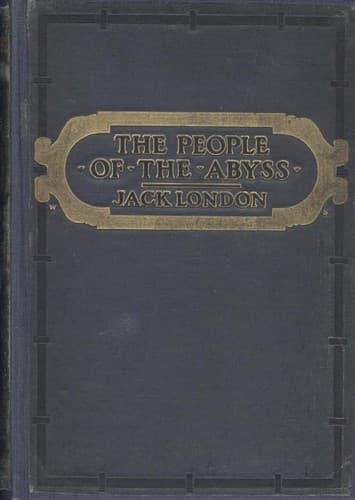
London (England) -- Social conditions; Poor -- England -- London
“You can’t do it, you know,” said the human emporium of routes and
fares at Cook’s Cheapside branch. “It is so—hem—so unusual.”
“Consult the police,” he concluded authoritatively, when I had
persisted. “We are not accustomed to taking travellers to the East End;
we receive no call to take them there, and we know nothing whatsoever
about the place at all.”
“Never mind that,” I interposed, to save myself from being swept out of
the office by his flood of negations. “Here’s something you can do for
me. I wish you to understand in advance what I intend doing, so that in
case of trouble you may be able to identify me.”
“Ah, I see! should you be murdered, we would be in position to identify
the corpse.”
He said it so cheerfully and cold-bloodedly that on the instant I saw
my stark and mutilated cadaver stretched upon a slab where cool waters
trickle ceaselessly, and him I saw bending over and sadly and patiently
identifying it as the body of the insane American who _would_ see the
East End.
“No, no,” I answered; “merely to identify me in case I get into a
scrape with the ’bobbies.’” This last I said with a thrill; truly, I
was gripping hold of the vernacular.
“That,” he said, “is a matter for the consideration of the Chief
Office.”
“It is so unprecedented, you know,” he added apologetically.
The man at the Chief Office hemmed and hawed. “We make it a rule,” he
explained, “to give no information concerning our clients.”
“But in this case,” I urged, “it is the client who requests you to give
the information concerning himself.”
Again he hemmed and hawed.
“Of course,” I hastily anticipated, “I know it is unprecedented, but—”
“As I was about to remark,” he went on steadily, “it is unprecedented,
and I don’t think we can do anything for you.”
However, I departed with the address of a detective who lived in the
East End, and took my way to the American consul-general. And here, at
last, I found a man with whom I could “do business.” There was no
hemming and hawing, no lifted brows, open incredulity, or blank
amazement. In one minute I explained myself and my project, which he
accepted as a matter of course. In the second minute he asked my age,
height, and weight, and looked me over. And in the third minute, as we
shook hands at parting, he said: “All right, Jack. I’ll remember you
and keep track.”
I breathed a sigh of relief. Having burnt my ships behind me, I was now
free to plunge into that human wilderness of which nobody seemed to
know anything. But at once I encountered a new difficulty in the shape
of my cabby, a grey-whiskered and eminently decorous personage who had
imperturbably driven me for several hours about the “City.”
“Drive me down to the East End,” I ordered, taking my seat.
“Where, sir?” he demanded with frank surprise.
“To the East End, anywhere. Go on.”
Public-domain text, read in full here on John Shaqi.
Reviews
Reviews
No reviews yet
Be the first to share your thoughts on this work.
Join the Discussion
Join the discussion
Sign in to leave a comment or review.
Sign InorCreate an account