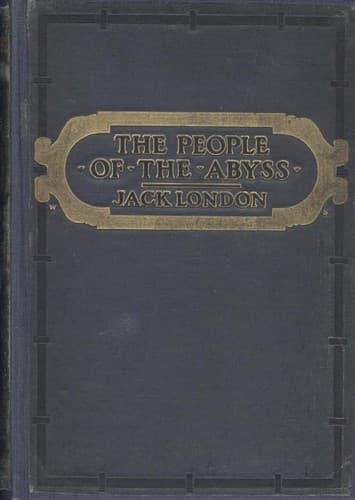
London (England) -- Social conditions; Poor -- England -- London
The hansom pursued an aimless way for several minutes, then came to a
puzzled stop. The aperture above my head was uncovered, and the cabman
peered down perplexedly at me.
“I say,” he said, “wot plyce yer wanter go?”
“East End,” I repeated. “Nowhere in particular. Just drive me around
anywhere.”
“But wot’s the haddress, sir?”
“See here!” I thundered. “Drive me down to the East End, and at once!”
It was evident that he did not understand, but he withdrew his head,
and grumblingly started his horse.
Nowhere in the streets of London may one escape the sight of abject
poverty, while five minutes’ walk from almost any point will bring one
to a slum; but the region my hansom was now penetrating was one
unending slum. The streets were filled with a new and different race of
people, short of stature, and of wretched or beer-sodden appearance. We
rolled along through miles of bricks and squalor, and from each cross
street and alley flashed long vistas of bricks and misery. Here and
there lurched a drunken man or woman, and the air was obscene with
sounds of jangling and squabbling. At a market, tottery old men and
women were searching in the garbage thrown in the mud for rotten
potatoes, beans, and vegetables, while little children clustered like
flies around a festering mass of fruit, thrusting their arms to the
shoulders into the liquid corruption, and drawing forth morsels but
partially decayed, which they devoured on the spot.
Not a hansom did I meet with in all my drive, while mine was like an
apparition from another and better world, the way the children ran
after it and alongside. And as far as I could see were the solid walls
of brick, the slimy pavements, and the screaming streets; and for the
first time in my life the fear of the crowd smote me. It was like the
fear of the sea; and the miserable multitudes, street upon street,
seemed so many waves of a vast and malodorous sea, lapping about me and
threatening to well up and over me.
“Stepney, sir; Stepney Station,” the cabby called down.
I looked about. It was really a railroad station, and he had driven
desperately to it as the one familiar spot he had ever heard of in all
that wilderness.
“Well,” I said.
He spluttered unintelligibly, shook his head, and looked very
miserable. “I’m a strynger ’ere,” he managed to articulate. “An’ if yer
don’t want Stepney Station, I’m blessed if I know wotcher do want.”
“I’ll tell you what I want,” I said. “You drive along and keep your eye
out for a shop where old clothes are sold. Now, when you see such a
shop, drive right on till you turn the corner, then stop and let me
out.”
I could see that he was growing dubious of his fare, but not long
afterwards he pulled up to the curb and informed me that an old-clothes
shop was to be found a bit of the way back.
“Won’tcher py me?” he pleaded. “There’s seven an’ six owin’ me.”
“Yes,” I laughed, “and it would be the last I’d see of you.”
Public-domain text, read in full here on John Shaqi.
Reviews
Reviews
No reviews yet
Be the first to share your thoughts on this work.
Join the Discussion
Join the discussion
Sign in to leave a comment or review.
Sign InorCreate an account