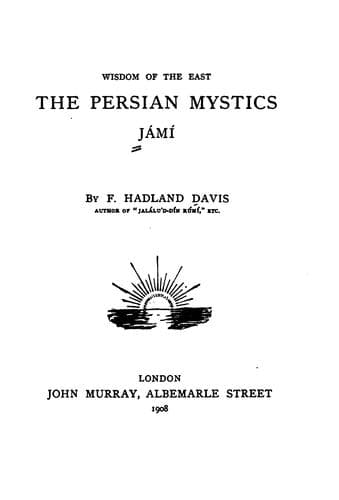
Jami, 1414-1492; Persian literature -- History and criticism; Persian literature -- Translations into English
The _Baháristán_, or "Abode of Spring," is admitted by Jámí to be
an imitation of Sa'di's _Gulistán_, or "Rose Garden." The idea of
arranging a book of verse and prose into a series of "Gardens" was
a very beautiful one. Two other books compiled on similar lines are
Sa'di's _Bústán_, or "Orchard," and the _Nigaristán_, or "Picture
Gallery," by Mu'in-uddin Jawini, which appeared in 1334 A.D. Sir
Edwin Arnold's _With Sa'di in a Garden_ gives the Westerner some
idea of the beauty of Eastern gardens, and this particular garden is
rendered all the more delectable because it holds a greater beauty
than the loveliest garden, the Taj Mahal itself. Sir Edwin transfers
Persian poetry to an Indian garden, which is not very dissimilar to
the beautiful gardens of Shiraz. Professor A. V. Williams Jackson[9]
describes the _Bagh-i-Takht_, "Garden of the Throne," thus: "Terrace
rises above terrace, and fountain, channel, and stream pour their
waters in cascades over slabs of marble into reservoirs faced with
stone--the walks bordered with cypress and orange trees." It would be
interesting to know if the terraces in any way corresponded with the
idea of naming and numbering the "Gardens" in Jámí's _Baháristán._ A
beautiful mosque, a bower of roses, running water; might not these
things alone have suggested to the poet's mind "The pavilion of
Excellency, Love, and Laughter?"
The _Baháristán_ has a distinct interest apart from its literary merit.
It appears to have been written by Jámí for the instruction of his
"darling and beloved son Ziá-uddin-Yúsuf." The poet-father goes on to
say, "That young boys and inexperienced youths become very disheartened
and unhappy when they receive instruction in idiomatic expressions
they are not accustomed to." Although Jámí allowed his son to read the
_Gulistán_, he evidently thought the last word had not yet been written
in the interests of instructing the young, and thus conceived the idea
of writing the _Baháristán_.
One is so apt to see printed requests in the public gardens of England
that it seems a little ironical to come across the following in the
literary "Gardens" of Jámí: "It is requested that the promenaders
in these gardens--which contain no thorns to give offence, nor
rubbish displayed for interested purposes,--walking through them with
sympathetic steps and looking at them carefully, will bestow their good
wishes, and rejoice with praise the gardener who has spent much trouble
and great exertions in planning and cultivating these gardens." In
regard to the statement that the _Gardens_ "contain no Thorns to give
offence," I, for one, must beg to differ. One ugly weed there is which
the gardener would have done well to destroy in his otherwise very
beautiful garden.
Public-domain text, read in full here on John Shaqi.
Reviews
Reviews
No reviews yet
Be the first to share your thoughts on this work.
Join the Discussion
Join the discussion
Sign in to leave a comment or review.
Sign InorCreate an account