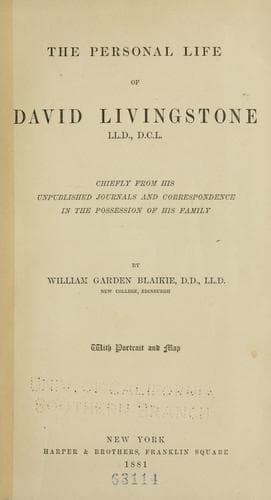
The Personal Life of David Livingstone: Chiefly from his Unpublished Journals and Correspondence in the Possession of His FamilyBlaikie, William Garden
Religion
The Personal Life of David Livingstone: Chiefly from his Unpublished Journals and Correspondence in the Possession of His Family
Blaikie, William Garden
Livingstone, David, 1813-1873
The family of David Livingstone sprang, as he has himself recorded, from
the island of Ulva, on the west coast of Mull, in Argyllshire. Ulva,
"the island of wolves," is of the same group as Staffa, and, like it,
remarkable for its basaltic columns, which, according to MacCulloch, are
more deserving of admiration than those of the Giant's Causeway, and
have missed being famous only from being eclipsed by the greater glory
of Staffa. The island belonged for many generations to the Macquaires, a
name distinguished in our home annals, as well as in those of Australia.
The Celtic name of the Livingstones was M'Leay, which, according to Dr.
Livingstone's own idea, means "son of the gray-headed," but according to
another derivation, "son of the physician." It has been surmised that
the name may have been given to some son of the famous Beatoun, who held
the post of physician to the Lord of the Isles. Probably Dr. Livingstone
never heard of this derivation; if he had, he would have shown it some
favor, for he had a singularly high opinion of the physician's office.
The Saxon name of the family was originally spelt Livingstone, but the
Doctor's father had shortened it by the omission of the final "e." David
wrote it for many years in the abbreviated form, but about 1857, at his
father's request, he restored the original spelling[1]. The significance
of the original form of the name was not without its influence on him.
He used to refer with great pleasure to a note from an old friend and
fellow-student, the late Professor George Wilson, of Edinburgh,
acknowledging a copy of his book in 1857: "Meanwhile, may your name be
propitious; in all your long and weary journeys may the _Living_ half of
your title outweigh the other; till after long and blessed labors, the
white _stone_ is given you in the happy land."
[Footnote 1: See Journal of Geographical Society, 1857, p. clxviii.]
Public-domain text, read in full here on John Shaqi.
Reviews
Reviews
No reviews yet
Be the first to share your thoughts on this work.
Join the Discussion
Join the discussion
Sign in to leave a comment or review.
Sign InorCreate an account