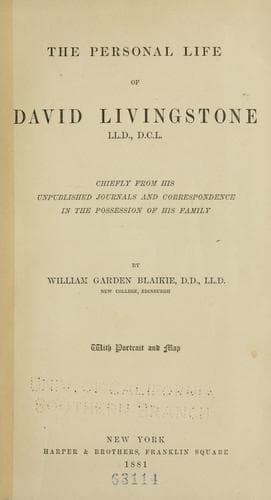
The Personal Life of David Livingstone: Chiefly from his Unpublished Journals and Correspondence in the Possession of His FamilyBlaikie, William Garden
Religion
The Personal Life of David Livingstone: Chiefly from his Unpublished Journals and Correspondence in the Possession of His Family
Blaikie, William Garden
Livingstone, David, 1813-1873
Livingstone has told us most that is known of his forefathers; how his
great-grandfather fell at Culloden, fighting for the old line of kings;
how his grandfather could go back for six generations of his family
before him, giving the particulars of each; and how the only tradition
he himself felt proud of was that of the old man who had never heard of
any person in the family being guilty of dishonesty, and who charged his
children never to introduce the vice. He used also to tell his children,
when spurring them to diligence at school, that neither had he ever
heard of a Livingstone who was a donkey. He has also recorded a
tradition that the people of the island were converted from being Roman
Catholics "by the laird coming round with a man having a yellow staff,
which would seem to have attracted more attention than his teaching,
for the new religion went long afterward--perhaps it does so still--by
the name of the religion of the yellow stick." The same story is told of
perhaps a dozen other places in the Highlands; the "yellow stick" seems
to have done duty on a considerable scale.
There were traditions of Ulva life that must have been very congenial to
the temperament of David Livingstone. In the "Statistical Account" of
the parish to which it belongs[2] we read of an old custom among the
inhabitants, to remove with their flocks in the beginning of each summer
to the upland pastures, and bivouac there till they were obliged to
descend in the month of August. The open-air life, the free intercourse
of families, the roaming frolics of the young men, the songs and
merriment of young and old, seem to have made this a singularly happy
time. The writer of the account (Mr. Clark, of Ulva) says that he had
frequently listened with delight to the tales of pastoral life led by
the people on these occasions; it was indeed a relic of Arcadia. There
were tragic traditions, too, of Ulva; notably that of Kirsty's Rock, an
awful place where the islanders are said to have administered Lynch law
to a woman who had unwittingly killed a girl she meant only to frighten,
for the alleged crime--denied by the girl--of stealing a cheese. The
poor woman was broken-hearted when she saw what she had done; but the
neighbors, filled with horror, and deaf to her remonstrances, placed her
in a sack, which they laid upon a rock covered by the sea at high water,
where the rising tide slowly terminated her existence. Livingstone
quotes Macaulay's remark on the extreme savagery of the Highlanders of
those days, like the Cape Caffres, as he says; and the tradition of
Kirsty's Rock would seem to confirm it. But the stories of the
"baughting-time" presented a fairer aspect of Ulva life, and no doubt
left happier impressions on his mind. His grandfather, as he tells us,
had an almost unlimited stock of such stories, which he was wont to
rehearse to his grandchildren and other rapt listeners.
Public-domain text, read in full here on John Shaqi.
Reviews
Reviews
No reviews yet
Be the first to share your thoughts on this work.
Join the Discussion
Join the discussion
Sign in to leave a comment or review.
Sign InorCreate an account