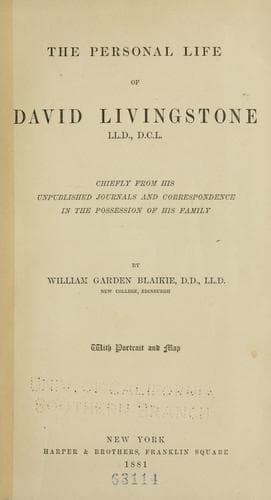
The Personal Life of David Livingstone: Chiefly from his Unpublished Journals and Correspondence in the Possession of His FamilyBlaikie, William Garden
Religion
The Personal Life of David Livingstone: Chiefly from his Unpublished Journals and Correspondence in the Possession of His Family
Blaikie, William Garden
Livingstone, David, 1813-1873
The Ulva emigrant had several sons, all of whom but one eventually
entered the King's service during the French war, either as soldiers or
sailors. The old man was somewhat disheartened by this circumstance, and
especially by the fate of Charles, head-clerk in the office of Mr. Henry
Monteith, in Glasgow, who was pressed on board a man-of-war, and died
soon after in the Mediterranean. Only one son remained at home, Neil,
the father of David, who eventually became a tea-dealer, and spent his
life at Blantyre and Hamilton. David Livingstone has told us that his
father was of the high type of character portrayed in the _Cottar's
Saturday Night_. There are friends still alive who remember him well,
and on whom he made a deep impression. He was a great reader from his
youth upward, especially of religious works. His reading and his
religion refined his character, and made him a most pleasant and
instructive companion. His conversational powers were remarkable, and he
could pour out in a most interesting way the stores of his reading and
observation.
Neil Livingstone was a man of great spiritual earnestness, and his whole
life was consecrated to duty and the fear of God, In many ways he was
remarkable, being in some things before his time. In his boyhood he had
seen the evil effects of convivial habits in his immediate circle, and
in order to fortify others by his example he became a strict teetotaler,
suffering not a little ridicule and opposition from the firmness with
which he carried out his resolution. He was a Sunday-school teacher, an
ardent member of a missionary society, and a promoter of meetings for
prayer and fellowship, before such things had ceased to be regarded as
badges of fanaticism. While traveling through the neighboring parishes
in his vocation of tea-merchant, he acted also as colporteur,
distributing tracts and encouraging the reading of useful books. He took
suitable opportunities when they came to him of speaking to young men
and others on the most important of all subjects, and not without
effect. He learned Gaelic that he might be able to read the Bible to his
mother, who knew that language best. He had indeed the very soul of a
missionary. Withal he was kindly and affable, though very particular in
enforcing what he believed to be right. He was quick of temper, but of
tender heart and gentle ways; anything that had the look of sternness
was the result not of harshness but of high principle. By this means he
commanded the affection as well as the respect of his family. It was a
great blow to his distinguished son, to whom in his character and ways
he bore a great resemblance, to get news of his death, on his way home
after his great journey, dissipating the cherished pleasure of sitting
at the fireside and telling him all his adventures in Africa.
Public-domain text, read in full here on John Shaqi.
Reviews
Reviews
No reviews yet
Be the first to share your thoughts on this work.
Join the Discussion
Join the discussion
Sign in to leave a comment or review.
Sign InorCreate an account