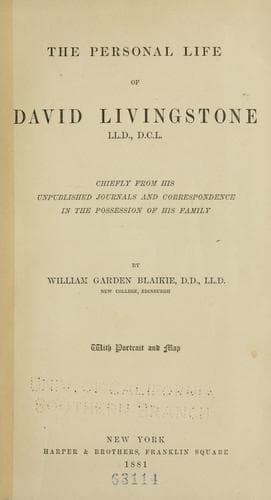
The Personal Life of David Livingstone: Chiefly from his Unpublished Journals and Correspondence in the Possession of His FamilyBlaikie, William Garden
Religion
The Personal Life of David Livingstone: Chiefly from his Unpublished Journals and Correspondence in the Possession of His Family
Blaikie, William Garden
Livingstone, David, 1813-1873
[Footnote 2: Kilninian and Kilmore. See _New Statistical Account of
Scotland_, Argyllshire, p. 345]
When, for the first and last time in his life, David Livingstone visited
Ulva, in 1864, in a friend's yacht, he could hear little or nothing of
his relatives. In 1792, his grandfather, as he tells us, left it for
Blantyre, in Lanarkshire, about seven miles from Glasgow, on the banks
of the Clyde, where he found employment in a cotton factory. The dying
charge of the unnamed ancestor must have sunk into the heart of his
descendant, for, being a God-fearing man and of sterling honesty, he was
employed in the conveyance of large sums of money from Glasgow to the
works, and in his old age was pensioned off, so as to spend his
declining years in ease and comfort. There is a tradition in the family,
showing his sense of the value of education, that he was complimented by
the Blantyre school-master for never grudging the price of a school-book
for any of his children--a compliment, we fear, not often won at the
present day. The other near relations of Livingstone seem to have left
the island at the same time, and settled in Canada, Prince Edward's
Isle, and the United States.
The influence of his Highland blood was apparent in many ways in David
Livingstone's character. It modified the democratic influences of his
earlier years, when he lived among the cotton spinners of Lanarkshire.
It enabled him to enter more readily into the relation of the African
tribes to their chiefs, which, unlike some other missionaries, he sought
to conserve, while purifying it by Christian influence. It showed itself
in the dash and daring which were so remarkbly combined in him with
Saxon forethought and perseverance. We are not sure but it gave a tinge
to his affections, intensifying his likes, and some of his dislikes too.
His attachment to Sir Roderick Murchison was quite that of a Highlander,
and hardly less so was his feeling toward the Duke of Argyll,--a man
whom he had no doubt many grounds for esteeming highly, but of whom,
after visiting him at Inveraray, he spoke with all the enthusiasm of a
Highlander for his chief.
Public-domain text, read in full here on John Shaqi.
Reviews
Reviews
No reviews yet
Be the first to share your thoughts on this work.
Join the Discussion
Join the discussion
Sign in to leave a comment or review.
Sign InorCreate an account