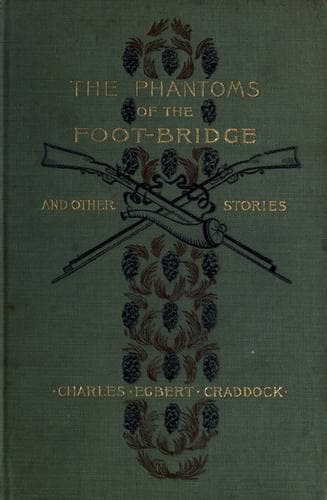
The Phantoms of the Foot-Bridge, and Other StoriesCraddock, Charles Egbert
General
The Phantoms of the Foot-Bridge, and Other Stories
Craddock, Charles Egbert
Cumberland Mountains -- Fiction; Mountain life -- Fiction; Tennessee -- Social life and customs -- Fiction
Mrs. Roxby's spectacles beamed upon him with an expression of the utmost
benignity as the firelight played on the lenses, but her eyes peering
over them seemed endowed in some sort with independence of outlook. It
was as if from behind some bland mask a critical observation was poised
for unbiased judgment. He felt in some degree under surveillance. But
when a light step heralded an approach he looked up, regardless of the
betrayal of interest, and bent a steady gaze upon Millicent as she
paused in the doorway.
And as she stood there, distinct in the firelight and outlined against
the black background of the night, she seemed some modern half-military
ideal of Diana, with her two gaunt hounds beside her, the rest of the
pack vaguely glimpsed at her heels outside, the perfect outline and
chiselling of her features, her fine, strong, supple figure, the look of
steady courage in her eyes, and the soldier's cap on her fair hair. Her
face so impressed itself upon his mind that he seemed to have seen her
often. It was some resemblance to a picture of a vivandière, doubtless,
in a foreign gallery--he could not say when or where; a remnant of a
tourist's overcrowded impressions; a half-realized reminiscence, he
thought, with an uneasy sense of recognition.
"Hello, Mill'cent! home agin!" Roxby cried, in cheery greeting as he
entered at the back door opposite. "What sorter topknot is that ye got
on?" he demanded, looking jocosely at her head-gear.
The girl put up her hand with an expression of horror. A deep red flush
dyed her cheek as she touched the cap. "I forgot 'twar thar," she
murmured, contritely. Then, with a sudden rush of anger as she tore it
off: "'Twar granny's fault. She axed me ter put it on, so ez ter see
which one I looked most like."
"Stranger," quavered the old woman, with a painful break in her voice,
"I los' fower sons in the war, an' Mill'cent hev got the fambly favor."
"Ye _mought_ hev let me know ez I war a-perlitin' round in this hyar
men's gear yit," the girl muttered, as she hung the cap on a prong of
the deer antlers on which rested the rifle of the master of the house.
Roxby's face had clouded at the mention of the four sons who had gone
out from the mountains never to return, leaving to their mother's
aching heart only the vague comfort of an elusive resemblance in a
girl's face; but as he noted Millicent's pettish manner, and divined her
mortification because of her unseemly head-gear in the stranger's
presence, he addressed her again in that jocose tone without which he
seldom spoke to her.
"Warn't you-uns apologizin' ter me t'other day fur not bein' a nephew
'stiddier a niece? Looked sorter like a nephew ter-night."
She shook her head, covered now only with its own charming tresses
waving in thick undulations to the coil at the nape of her neck--a
trifle dishevelled from the rude haste with which the cap had been torn
off.
Public-domain text, read in full here on John Shaqi.
Reviews
Reviews
No reviews yet
Be the first to share your thoughts on this work.
Join the Discussion
Join the discussion
Sign in to leave a comment or review.
Sign InorCreate an account