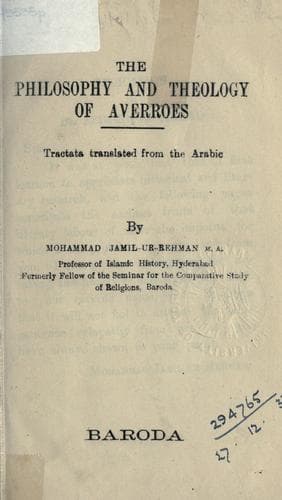
The Philosophy and Theology of Averroes — John Shaqi
The Philosophy and Theology of AverroesAverroës
ReligionIslamic
The Philosophy and Theology of Averroes
Averroës
Islam and philosophy; Philosophy, Arab
Again, time is one of the accidents, the creation of which it is
impossible to imagine, for it is necessary that the non-existence of
a thing be preceded by time. But in this case it cannot be imagined
that the non-existence of a thing can be preceded by itself, except
by accepting time as existent. So also it is difficult to imagine the
creation of the space in which the universe is, for every existent
thing occupies a former space. For if it is a void, as is the opinion
of those who think that the void itself is space, its creation also,
if we suppose it to be created, must been have preceded by another
void. And if the space be a tangible body, as is the opinion of another
group, then it should be contained in another body, which would require
another, and so on without limit. These are all obscure problems
and the arguments which are brought to disprove the eternity of the
accidents, are necessary for one who believes in the eternity of those
accidents which can be perceived; that is, one who asserts that not all
the accidents are created. For they say that the accidents which can be
perceived by the senses are created things. If they are not created,
then they will move from one place to another, or will be latent in the
place in which they are to appear, before they make their appearance.
Then they disprove both of these arguments, and think that they have
established that all the accidents are created things. But it has
become apparent from what they have said, that the apparently created
portions of the accidents are created, not those whose creation is not
apparent, nor those in whose case there is doubt, such as the accidents
which are in the heavenly bodies, in their movement, in their shape,
etc., etc. So their arguments about the creation of all accidents, can
be interpreted by the analogy of the visible to the invisible. This
is an exhortative argument, except in the suggestion of reasonable
arguments which depend here on the certainty of the similarity of the
character of the visible and the invisible.
Public-domain text, read in full here on John Shaqi.
Reviews
Reviews
No reviews yet
Be the first to share your thoughts on this work.
Join the Discussion
Join the discussion
Sign in to leave a comment or review.
Sign InorCreate an account