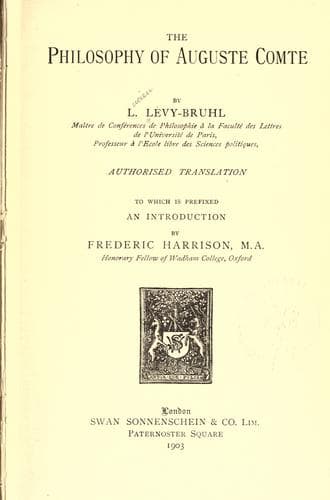
Professor Lévy-Bruhl followed up his _History of Modern Philosophy in
France_ by a substantial work on the philosophy of Auguste Comte. It
forms a volume of the _Bibliothèque de Philosophie Contemporaine_,
which has already devoted four other works to the Positive Philosophy.
It is as well to premise that this treatise dealt solely with the
_philosophy_, not with the polity, or any part of the religious scheme
of Comte. Professor Lévy-Bruhl writes as a student, but not as an
adherent of Auguste Comte. His entire work is rather an exposition, not
a refutation, or a criticism, or an advocacy of Comte’s philosophical
system. But it may be said at once that no one abroad or at home,
certainly neither Mill, nor Lewes, nor Spencer, nor Caird, has so truly
grasped and assimilated Comte’s ideas as M. Lévy-Bruhl has done.
In his _Introduction_ M. Lévy-Bruhl very clearly states the scope of
his work, and his own general attitude. He traces the origin of Comte’s
philosophy in the mental effervescence of the first generation of
the present century towards a reorganisation of society, after the
upheaval left by the Revolution and its consequences. He correctly
states the relation of St. Simon to Comte as being that of an initial
stimulus. The cardinal difference between Comte and all the socialists
and founders of social and religious Utopias consisted in this,
that Comte saw the necessity of a new system of philosophy as the
indispensable preliminary to any reorganisation of society. In 1824, at
the age of twenty-six, Comte wrote:—“Discussions about institutions are
pure folly until the spiritual reconstitution of society is effected
or much advanced.” The construction of an intellectual reorganisation,
before any social restoration was possible, occupied twenty or thirty
years of Comte’s life. And when he opened his _Polity_, or social and
religious scheme, the conditions had much changed: the public and its
interests were no longer what they had been in 1820-30.
M. Lévy-Bruhl effectively disposes of the objection of Littré, to which
Mill gave countenance, that the _Polity_, with the whole of Comte’s
second or social system, was in contradiction with his first and
philosophic system as propounded in the _Philosophy_. As M. Lévy-Bruhl
proves, the six _Opuscules_ dating from 1819 to 1826, some years before
the _Cours_, which only began in 1830 and occupied twelve years,
contain in germ the scheme ultimately elaborated in the _Politique_,
from 1851 to 1854. Besides this, the _Letters to Mill_, which M.
Lévy-Bruhl edited in 1899, and the _Letters to Valat_, which are long
antecedent to the _Politique_, show the same governing design. To the
unity of Comte’s doctrine M. Lévy-Bruhl bears emphatic testimony:—
“His whole life was the methodical execution of his programme.... He
had but one system, not two. From the _Opuscules_ of his twentieth
year, to the _Synthèse_ of his last year, it is the development of one
and the same conception.”
Public-domain text, read in full here on John Shaqi.
Reviews
Reviews
No reviews yet
Be the first to share your thoughts on this work.
Join the Discussion
Join the discussion
Sign in to leave a comment or review.
Sign InorCreate an account