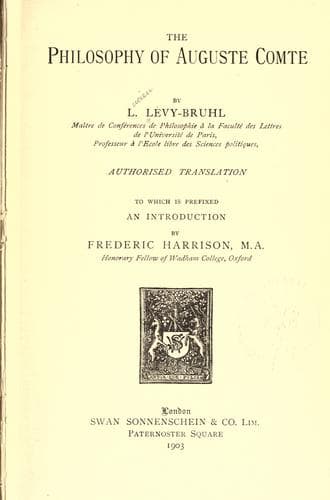
M. Lévy-Bruhl then explains that, whilst recognising the entire
coherence of Comte’s collective labours, he proposes to confine his
present study to the earlier and principal work, the _Philosophy_,
which in M. Lévy-Bruhl’s opinion is the dominant and more fruitful
composition.
This he regards as the representative work of the nineteenth century,
as shown by the intellectual history of the period. He points to its
influence on thought in England, in Europe, and in America. It will
surprise many persons to learn that in M. Lévy-Bruhl’s opinion two
eminent French writers, who assuredly neither were, nor were supposed
to be, Positivists, “have done more for the diffusion of the ideas and
method of Comte than Littré and all the other Positivists together.”
These two are Taine and Renan, much as they differed from Comte’s
actual scheme and doctrines. Renan indeed spoke of Comte as destined
to prove one of the typical names of the century. The present writer
remembers Renan saying to him with a most genial welcome, “I too am a
believer in the religion of humanity.” History, romance, poetry, says
M. Lévy-Bruhl, have all reflected the positive spirit:—
“Contemporary sociology is the creation of Comte; scientific
psychology, in a certain degree has sprung from him. It is not rash
to conclude that the Positivist Philosophy expresses some of the most
characteristic tendencies of the age.”
It is clear that, if M. Lévy-Bruhl is in no sense an adherent of Comte,
he is a most sympathetic and discerning master of the positive system.
M. Lévy-Bruhl opens his analysis of Comte’s philosophy by examining
his main conceptions:—(1) The law of the three states, theological,
metaphysical, and positive, through which all human ideas pass; (2) the
Classification of the Sciences; (3) the scheme of each science in turn.
And he closes with an explanation of the general doctrines of Humanity,
as the centre of human thought, feeling, and activity.
The law of the three states announced by Comte in 1822, is thoroughly
explained and entirely assimilated by M. Lévy-Bruhl. Its demonstration,
he thinks, is complete when we recognise that, although many orders
of ideas have not finally reached their positive state, all of them
exhibit the tendency to the same evolution, and there is no single
instance of a conception of a positive science ever retrograding
into unverified figment. Of course the terms _theological_ and
_metaphysical_ have to be understood in the sense adopted by
Comte--_i.e._ “anthropomorphic” and “hypothetical,” a bare hypothesis
wearing a scientific form. M. Lévy-Bruhl himself regards the law
as irrefutable and of capital importance, “the corner stone of the
positive system.”
Public-domain text, read in full here on John Shaqi.
Reviews
Reviews
No reviews yet
Be the first to share your thoughts on this work.
Join the Discussion
Join the discussion
Sign in to leave a comment or review.
Sign InorCreate an account