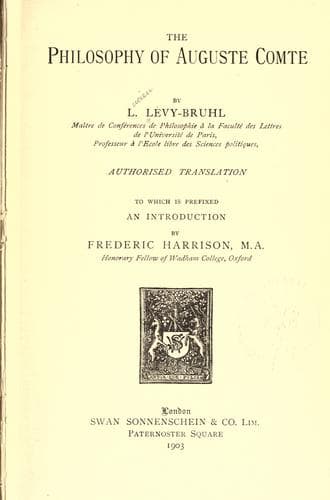
By his _Politique positive_ Comte only represents his generation. By
his philosophy properly so called he is a “representative man” of
his entire century. Is it necessary to prove this? The intellectual
history of our age witnesses to it at every step. Of all the systems
which found birth in France in the XIX. century, this one alone found
a hearing beyond the frontiers and left a deep impression upon foreign
thinkers. Comte’s philosophy was at first received in England and in
Holland even with more sympathy than in France. John Stuart Mill,
Herbert Spencer, George Lewes, George Elliot and a number of English
philosophers and writers drew more or less of their inspiration from
it. To this day, it is defended by men of great talent in England. It
is true that no German philosopher had the same personal relations
with Comte as John Stuart Mill, but as a matter of fact, for thirty
years the positive spirit has gradually gained ground in the German
Universities. To be convinced of this, it is enough to see how
metaphysics are set aside in them and to observe the lines on which the
moral and social sciences are taught. In the Latin countries of the
two hemispheres Comte’s influence has been exercised with even greater
strength, in Spain, in Portugal, in South America; and North America
has also its Positivist societies. In his life time, Comte had already
found there some of his most devoted disciples. In France the principal
“vehicles” of Positivist philosophy have been the works of two writers
who, in their time, were those most beloved by the public; Renan and
Taine, although they were not positivists, have perhaps done more for
the diffusion of the ideas and method of Comte than Littré and all the
other positivists together.
It is true that Taine owes a great deal to Spinoza and to Hegel, and
more still to Condillac. Among his contemporaries he seems to be
especially connected with John Stuart Mill and Spencer. But through
them it is from Comte that he proceeds, and there we find the origin
of the greater number of his leading ideas. His conception of literary
history, of criticism, of the philosophy of art, in a word, his effort
to bring into the study of the moral sciences the method used in the
natural sciences, all this is chiefly derived from Auguste Comte. The
_Histoire de la Litterature anglaise_ is, in a sense, an application
of the positive theory according to which the evolution of the arts
and literatures is governed by necessary laws which constitute its
solidarity with that of morals, of institutions and of beliefs. The
theory of the “moment” and of the “milieu” which is the chief one in
Taine’s work was certainly not unknown in the XVIII. century. But it
is Comte who generalised it by bringing Lamarck nearer to Montesquieu;
it is he who taught Taine the general definition, at once biological
and social, of the idea of the “milieu.”
Public-domain text, read in full here on John Shaqi.
Reviews
Reviews
No reviews yet
Be the first to share your thoughts on this work.
Join the Discussion
Join the discussion
Sign in to leave a comment or review.
Sign InorCreate an account