One of the most common of these misconceptions is the ignorant charge
that Comte repudiated “psychology,” in the sense of the laws of man’s
intellectual and moral nature. “_Psychologie_,” as M. Lévy-Bruhl
shows, when Comte wrote, meant Cousin’s futile introspection of the
_ego_. Comte certainly rejected that as idle, as do all competent
psychologists of our time. Psychology, meaning the laws of mind and
will, was not only an indispensable basis of Comte’s system, but its
rational, systematic foundation dates from Comte’s suggestions. His
signal contribution to psychology lies, not in his doctrine of its
physiological basis, but in his referring it to sociology as its guide
and inspiration.
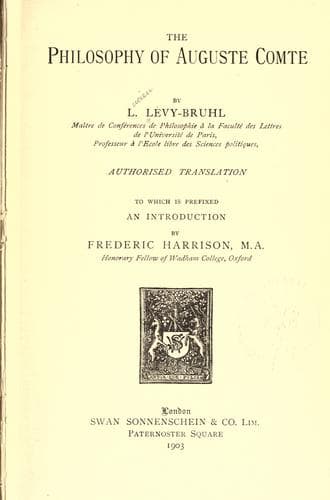
M. Lévy-Bruhl concludes his study with a co-ordinate table of twelve
contrasted propositions of the metaphysical and of the positive
systems respectively. These show how simple and rational a transition
is that between Positivism and the older theological and metaphysical
hypotheses of the universe and of Man. We welcome a book which all
positivists will regard as fair, learned, and instructive, and which
all students of philosophy must regard as a masterly study of a
comprehensive subject.
_45th Anniversary of the death of Comte_,
(5th SEPTEMBER, 1902.)
TRANSLATOR’S PREFACE
Fifty years have now elapsed since Auguste Comte’s monumental work,
the _Cours de Philosophie Positive_, was first introduced to English
readers by Miss Harriet Martineau. But her work was much more than a
translation. It was a condensed exposition of Comte’s doctrines, done
with such mastery that it obtained the emphatic approval of Comte
himself who, in such matters, was not very easily satisfied.
In Harriet Martineau’s case, both the substance of the book and
the English form in which it was offered to the public, were her
work. In the case of the present volume, while a woman is once more
responsible for the translation, the substance of the book, that is
the comprehensive exposition of Comte’s system in the light of all his
published works, is from the pen of Professor Lévy-Bruhl, and readers
who are acquainted with Harriet Martineau’s book will be all the more
in a position to appreciate the importance of this fresh contribution
to the elucidation of the thought of Auguste Comte.
We fear that the clearness of style, the richness of expression, the
power of condensed thought which characterise our author will be found
to have been often weakened, if not sometimes altogether obliterated,
in this translation. The striking simplicity of the text at first
deceived me into the belief that I could do justice to it. I was often
tempted to sacrifice the literal sense in order to preserve some of the
graces of the original. Yet I hope to be forgiven for having uniformly
preferred to err through too much faithfulness to the letter. My sole
object has been to enable the English reader to get at the meaning of
the text.
Public-domain text, read in full here on John Shaqi.
Reviews
Reviews
No reviews yet
Be the first to share your thoughts on this work.
Join the Discussion
Join the discussion
Sign in to leave a comment or review.
Sign InorCreate an account