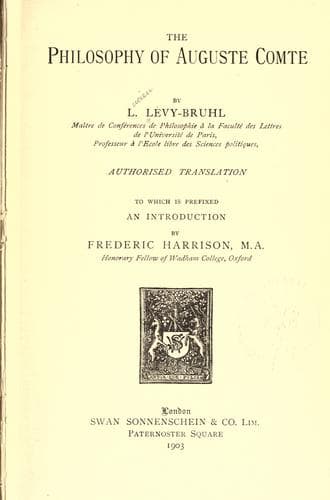
Our professor is equally conclusive in his estimate of Comte’s
classification of the sciences. He quite demolishes the objections
made to it by Mr. Herbert Spencer in his essay with that title. M.
Lévy-Bruhl repeats the criticisms to which Spencer has been exposed in
this country and abroad by Littré, Lewes, Mill, and others. And he has
no difficulty in showing that Mr. Spencer’s objections are due to his
very slight acquaintance with Comte’s text, and his own superficial
study of the English abridgments. In proposing a classification of
the _concrete_ sciences, Mr. Spencer enters on a task which Comte
distinctly repudiates, and which on good grounds he treats as
philosophically impracticable for purposes of evolutionary sequence.
Comte’s strictly _relative_ theory excludes such a scale of _concrete_
science; whilst Spencer’s _absolute_ theory of the universe forces
him to attempt it in vain. If it be objected that Comte’s ascending
scale of the sciences is “anthropocentric,” the answer is that, when
reasonably understood as a philosophic device for sorting human
ideas, not as a statement of _absolute_ truth, the “anthropocentric”
arrangement of human knowledge is the only one which is at once
possible and useful.
It would need a long essay even to sketch M. Lévy-Bruhl’s analysis of
Comte’s conception of _science_, of _law_, and of the six dominant
sciences. He has thoroughly assimilated the positive spirit, that
_science_ implies a co-ordination of _laws_, not an encyclopædia of
facts, that it is _relative_ to our powers of observation and reasoning
and not an _absolute_ explanation of the universe in itself. He goes
through the sciences, physical, social, and moral, in turn, as treated
by Comte, and justly explains that Comte never attempted or conceived
a _vade-mecum_ or handbook of contemporary scientific knowledge, but
a scheme for the co-ordination of general ideas of science. A real
“philosophy of the sciences” is something wholly distinct from a
compendium of all the sciences--a thing which in 1840 was far less
possible than it might be now. Controversialists have reproached Comte
with the obvious fact that his concrete science is now sixty years
old. In dealing with these shallow criticisms, M. Lévy-Bruhl has shown
how little able is any narrow specialist to understand the abstract
conceptions of a real philosopher.
Public-domain text, read in full here on John Shaqi.
Reviews
Reviews
No reviews yet
Be the first to share your thoughts on this work.
Join the Discussion
Join the discussion
Sign in to leave a comment or review.
Sign InorCreate an account