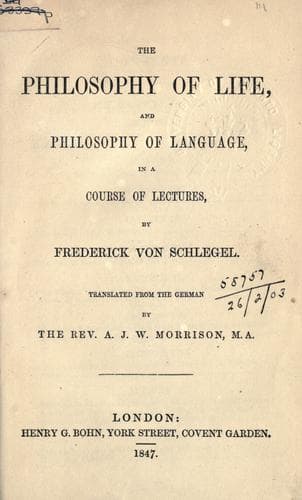
The philosophy of life, and philosophy of language, in a course of lecturesSchlegel, Friedrich von
Philosophy
The philosophy of life, and philosophy of language, in a course of lectures
Schlegel, Friedrich von
Language and languages -- Philosophy; Life; Philosophy
The sufferings of animals are indeed a theme for man to reflect upon;
and I, for my part, can not concur with him who would regard this as a
topic unworthy of his thoughts, and expel from the human bosom all
sympathy with the animal creation. The consideration, however, of this
subject, naturally enough gives rise to the question as to the soul of
animals. Now, it certainly would do no discredit to philosophy, if it
should succeed in giving a satisfactory answer to this question, and
enable us to follow a middle course; as remote from the exaggerated
assumptions of ancient nations with regard to animal existence, on the
one hand, as on the other, from the unfeeling conclusions of modern
science, which refuses to regard or to sympathize with any pains, and
absolutely is unable to conceive the sufferings of any being which does
not possess the character of rationality exactly in the same manner and
degree as man. As greatly, on the other side, does the Hindoo theology
err. Its dogma of the metempsychosis not only ascribes an immortal soul
to animals, but it also further teaches that human souls are imprisoned
in animal bodies, as the penalty of a guilt incurred in a previous state
of existence. Beautiful, however, as is the compassionate sympathy with
the sufferings of the brute creation, which this theory has occasioned,
and confirmed by the sanction of a religious duty, still the assumption
on which it is founded is wholly arbitrary, and the extension of the
immortality of the soul to these creatures of our globe is an
unwarrantable exaggeration, and has no foundation in observed phenomena.
Moreover, the hypothesis of such a migratory state of departed souls is
inconsistent with every notion of the divine government of the world;
inasmuch as such a temporary punishment can produce no salutary effect,
either of purification or of preparation, and consequently would be
wholly motiveless and absurd.
Very questionable, moreover, does it seem, whether, with propriety, an
individual soul can be attributed to animals. With those that are most
closely domesticated with man, there does undoubtedly arise, as it were,
by a sort of mental contagion, the appearance of individuality and
difference of character, just as the artistic structures of certain
species form a kind of analogy to human reason, and as the melodious
intonations and feelings of some others seemed to me entitled, in a
similar sense, to be termed reverberations of fancy. In all those kinds,
however, which remain undisturbed in their natural state, the whole
species possesses the same character, and have, consequently, the same
common soul.[30] The species itself is only an individual; and,
consequently, the several species must be considered as so many living
forms of the general organic force of animated nature, since an
immortality of individual souls can, in the case of animals, neither be
assumed nor allowed to be assumable.
Public-domain text, read in full here on John Shaqi.
Reviews
Reviews
No reviews yet
Be the first to share your thoughts on this work.
Elsewhere in the archive
Join the Discussion
Join the discussion
Sign in to leave a comment or review.
Sign InorCreate an account