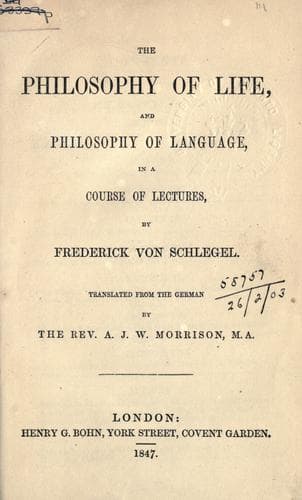
The philosophy of life, and philosophy of language, in a course of lecturesSchlegel, Friedrich von
Philosophy
The philosophy of life, and philosophy of language, in a course of lectures
Schlegel, Friedrich von
Language and languages -- Philosophy; Life; Philosophy
Among those perplexities, or, as I termed them, questioning feelings
about nature and its animating principle, I turn now to the
consideration of the last instance, that of the maggots of putrefaction.
Is not this one of the clearest possible proofs that all nature is
animated?[31] So much so, and so eminently is this the case, that even
in death and corruption, in foulness and disease, it still livingly
operates and produces life--the lowest grade, undoubtedly, of life--or,
if any so prefers to call it, a false life--but still a life. Now, can
such morbid productions of nature, the worms, _e.g._ [_entozoa_], which
in certain diseases are engendered in the bowels, be regarded as real
creatures? Naught are they but the dissolving and crumbling matter of
life, which even in dissolution is still living.[32] And this fact is
not confined merely to organic corruption and disease. Even the
element--the fresh water from the spring--is full of life, and it is the
more so the clearer and the better it is and the purer from the
microscopic animalculæ, which swarm in it more and more the longer it
stagnates and becomes foul, until at last, as frequently happens when it
has been kept long on shipboard, with the growing foulness of the water
they increase in size, and swim about as worms of visible magnitude.
Many other instances might be adduced in proof of this origination of
worms and vermin out of corruption, and testifying to it as a general
principle of nature. And are not those swarms of locusts which in
Asiatic countries are a general plague of the lands over which they
sweep with their thick and dark migratory hordes, a sickly proof that
the atmosphere that has engendered them is passing, or has already
fallen into corruption beneath the influence of some other contagious
element?
That the air and atmosphere of our globe is in the highest degree full
of life, I may, I think, take here for granted and generally admitted.
It is, however, of a mixed kind and quality, combining the refreshing
and balsamic breath of spring with the parching simoons of the desert,
and where the healthy odors fluctuate in chaotic struggle with the most
deadly vapors. What else, in general, is the wide-spread and spreading
pestilence, but a living propagation of foulness, corruption, and death?
Are not many poisons, especially animal poisons, in a true sense, living
forces?
Public-domain text, read in full here on John Shaqi.
Reviews
Reviews
No reviews yet
Be the first to share your thoughts on this work.
Elsewhere in the archive
Join the Discussion
Join the discussion
Sign in to leave a comment or review.
Sign InorCreate an account