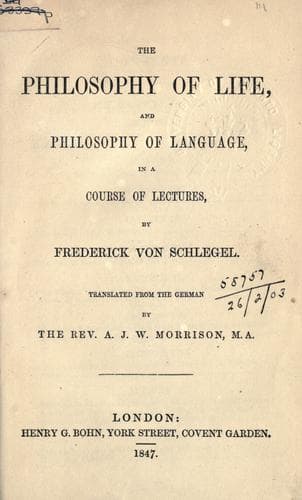
The philosophy of life, and philosophy of language, in a course of lecturesSchlegel, Friedrich von
Philosophy
The philosophy of life, and philosophy of language, in a course of lectures
Schlegel, Friedrich von
Language and languages -- Philosophy; Life; Philosophy
Now, may we not give a further extension to this mode of view, and
apply the fact of a diseased propagation of a false life, as in the
worms of putrefaction, to other unsightly productions of nature. May we
not, for instance, consider serpents and snakes as the entozoa or
intestinal worms of the earth? That the evil spirits are not without
some influence on our terrestrial habitation, and that in many places
their malignant influence is distinctly traceable is, at all events,
undeniable. And accordingly, some have supposed the monkey tribe not to
be an original creation of the Deity, but a satanic device and malicious
parody upon man, as the envied favorite of God. That the “Prince of this
world”--which expression, in its latter half, is surely not to be
understood exclusively of man’s fallen race, but very evidently and
expressively alludes to the existing fabric of nature and the corrupted
world of sense--that the Prince of this world can exercise a certain
degree of pernicious influence on the productive energies of the natural
system in its present corrupt and vitiated condition, and that also,
there is in nature itself a power to produce evil, are facts which do
not admit of denial, and are noways inconsistent with revelation. Only
we must not suppose that this baneful influence is not confined within
certain limits. He to whom the Prince of this world, no less than the
world itself, is subject, has, in His infinite wisdom, set a definite
limit both of quantity and duration to this pernicious influence, as, in
general, He does to every permission of evil.
At all events we must not for one moment suppose that in the book of
nature we have a pure and uncorrupt text of God, and such as it
originally came from the hands of its Author. It is of the highest
consequence, for a due and right appreciation of the divine economy in
nature, that we give full consideration to this fact. On this account it
is important to keep in mind the distinction implied in that expression
already quoted from the Mosaic history--“Let the earth bring forth.”
For, according to this, it does not seem indispensably necessary to
ascribe immediately to the good and wise Creator every thing that the
earth brought forth; no, nor every thing that is produced by a nature
now so imperfect--so diseased, too, in many parts--and visibly
constrained to submit to hostile and foreign influences.
Public-domain text, read in full here on John Shaqi.
Reviews
Reviews
No reviews yet
Be the first to share your thoughts on this work.
Elsewhere in the archive
Join the Discussion
Join the discussion
Sign in to leave a comment or review.
Sign InorCreate an account