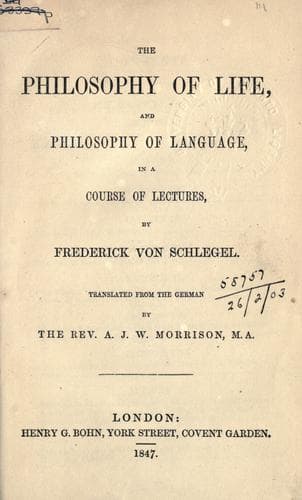
The philosophy of life, and philosophy of language, in a course of lecturesSchlegel, Friedrich von
Philosophy
The philosophy of life, and philosophy of language, in a course of lectures
Schlegel, Friedrich von
Language and languages -- Philosophy; Life; Philosophy
than an opposition of the reason itself to some other principle equally
valid and extensive. The principal, or, rather, only way which foreign
philosophy took in this pursuit, was to reduce every thing to sensation
as opposed to reason, and to derive every thing from it alone, so as to
make the reason itself merely a secondary faculty, no original and
independent power, and ultimately nothing else than a sort of chemical
precipitate and residuum from the material impressions.[3] But however
much may be conceded to these and to the external senses, and however
great a share they may justly claim in the whole inner property of the
thinking man, still it is evident that the perception of these sensuous
impressions, the inner coherence--in short, the unity of the
consciousness in which they are collected--can never, as indeed it has
often been objected on the other side, have come into the mind from
without. This was not, however, the end which this doctrine had
exclusively, or even principally, in view. The ultimate result to which
they hoped to come by the aid of this premise was simply the negation of
the suprasensible. Whatever in any degree transcends the material
impression, or sensuous experience, as well as all possible knowledge
of, and faith therein, not merely in respect to a positive religion, but
absolutely whatever is noble, beautiful, and great--whatever can lead
the mind to, or can be referred to a something suprasensible and
divine--all this, wherever it may be found, whether in life or thought,
in history or in nature--ay, even in art itself--it was the ultimate
object of this foreign philosophy to decry, to involve in doubt, to
attack and to overthrow, and to bring down to the level of the common
and material, or to plunge it into the skeptical abyss of absolute
unbelief. The first step in this system was a seeming subordination of
reason to sensation, as a derivative of it--a mere slough which it
throws off in its transformations. Afterward, however, the warfare
against the suprasensible was waged entirely with the arms of reason
itself. The reason, indeed, which supplied these weapons was not one
scientifically cultivated and morally regulated, but thoroughly
sophistical and wholly perverted, which, however, put into requisition
all the weapons of a brilliant but skeptical wit, and moved in the
ever-varied turnings of a most ingenious and attractive style. Here,
where the question was no longer the abrogation of any single dogma of
positive religion, but where the opposition to the divine had become the
ruling tendency of philosophy, it is not easy to refrain from
characterizing it as atheistical--what, indeed, in its inmost spirit it
really was, and also historically proved itself by its results.
Public-domain text, read in full here on John Shaqi.
Reviews
Reviews
No reviews yet
Be the first to share your thoughts on this work.
Join the Discussion
Join the discussion
Sign in to leave a comment or review.
Sign InorCreate an account