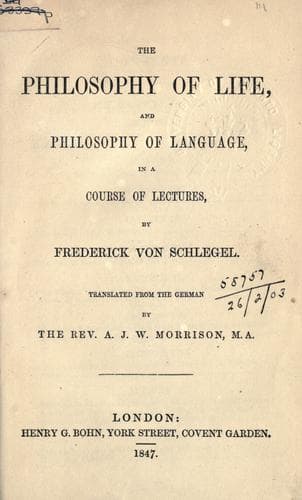
The philosophy of life, and philosophy of language, in a course of lecturesSchlegel, Friedrich von
Philosophy
The philosophy of life, and philosophy of language, in a course of lectures
Schlegel, Friedrich von
Language and languages -- Philosophy; Life; Philosophy
If now, in the present course of Lectures, I shall succeed in laying
before you my subject in that clearness and distinctness which are
necessary to enable you to comprehend the whole, and, while taking a
survey of it, to judge of the agreement of the several parts, you will
find, I trust, no difficulty in discovering the fundamental idea and
sentiment. And further, I would venture to entreat you not to judge
hastily of this sentiment from single expressions, and least of all at
the very outset, but, waiting for its progressive development, to judge
of it on the whole. Lastly, I would also indulge a hope that the views
of an individual thinker, if perspicuously enunciated, may, even where
they fail of conviction, and though points of difference still subsist,
produce no revolting impression on your minds; but, by exercising a
healing influence on many a rankling wound in thought and life, produce
among us some of the fairest fruits of true philosophy.
Hitherto we have been considering, first of all, the object and proper
sphere of the philosophy of life; and, secondly, its appropriate form of
communication, as well as all other methods which are alien and foreign
to it. Of great and decisive importance for the whole course and further
development of philosophical inquiry is it to determine, in the next
place, the starting-point from which it ought to set out. It will not do
to believe that we have found this in any axiom or postulate such as are
usually placed at the head of a system. For such a purpose we must
rather investigate the inmost foundation--the root out of which springs
the characteristic feature of a philosophical view. Now, in the
philosophy of life the whole consciousness, with all its different
phases and faculties, must inevitably be taken for the foundation, the
soul being considered as the center thereof. This simple basis being
once laid, it may be further developed in very different ways. For it
is, I might almost say, a matter of indifference from what point in the
circumference or periphery we set out in order to arrive at the center,
with the design of giving a further development to this as the
foundation of the whole. But in order to illustrate this simple method
of studying life from its true central point, which is intermediate
between the two wrong courses already indicated, and in order to make,
by contrast, my meaning the plainer, I would here, in a few words,
characterize the false starting-point from which the prevailing
philosophy of a day--whether that of France in the eighteenth century or
the more recent systems of Germany--has hitherto, for the most part,
proceeded. False do I call it, both on account of the results to which
it has led, and also of its own intrinsic nature. In one case as well as
in the other, the starting-point was invariably some controverted point
of the reason--some opposition or other to the legitimacy of the
reason--under which term, however, little else generally was understood
Public-domain text, read in full here on John Shaqi.
Reviews
Reviews
No reviews yet
Be the first to share your thoughts on this work.
Join the Discussion
Join the discussion
Sign in to leave a comment or review.
Sign InorCreate an account