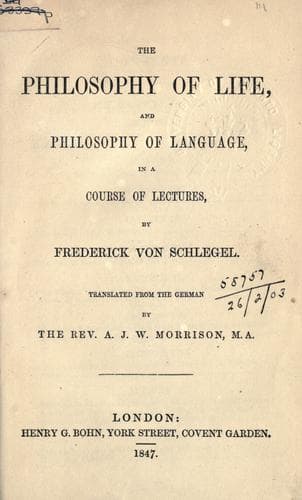
The philosophy of life, and philosophy of language, in a course of lecturesSchlegel, Friedrich von
Philosophy
The philosophy of life, and philosophy of language, in a course of lectures
Schlegel, Friedrich von
Language and languages -- Philosophy; Life; Philosophy
other lands, while she has acquired from it a great and important
position in the world of the future. Considered with regard to the whole
world, one can not well avoid ascribing to this indestructible religious
peace in Germany a still higher importance, however little it is
commonly understood or regarded in this light. Indeed, we can not but
look upon it as the precursor, with hopeful promises, of a far greater
and completer religious peace--a peace, I mean, which shall reconcile
not only all differences in the faith, but also that more universal and
more pervading dissension between faith and unbelief; the quarrel
between science and faith being first adjusted, and unity restored
thereby between them, and, consequently, also to life. But to effect
this object, God, who wills nothing but peace and unity, must take the
upper hand and be stronger than man, who loves and desires strife, or,
at least, without loving and seeking it, is still ever relapsing into
it.
In such or some similar way a religious view of universal history, and
of the divine order therein, admits of being developed; which, however,
can not be truly done with too much of scientific rigor, or by violently
introducing into its plans any arbitrary and, consequently, false
designs and purposes.
My prescribed limits compel me to confine myself to these few hints, and
in these I have wished principally to call attention to their reference
to our own age, and to exhibit them in the light in which they appear of
universal interest and to possess an eminent and remarkable destination.
Comprised, then, in one result, the following are the characteristic
signs of the present age: the two greatest heathen nations, which for
thousands of years stood by themselves apart from the rest of the world,
have lately come into the closest contact with Europe--the Mohammedan
empires are every where falling into decay, more rapidly than men had
been led to expect their fall--the Hebrew race is beginning to rise from
its long degradation--in Christian states and communities there is here
and there visible a strong inclination to the old evil of anarchy--and
if the great human peace, which has now lasted twelve years, appears in
some points insecure, or at least endangered from within, it is only
because it is devoid of a firm foundation of the internal sentiment of
men. What event, then, could be more happy for our age, what better turn
could the present posture of affairs take, than by bringing about such a
triple divine peace as we have already sketched, to give a new
foundation and a firmer basis to the external peace of society? May not
this, in God’s good purpose, be the theme which is to occupy the next
era of the world?
LECTURE IX.
OF THE TRUE DESTINATION OF PHILOSOPHY, AND OF THE APPARENT SCHISM BUT
ESSENTIAL UNITY BETWEEN A RIGHT FAITH AND HIGHEST CERTAINTY, AS THE
CENTER OF LIGHT AND LIFE IN THE CONSCIOUSNESS.
Public-domain text, read in full here on John Shaqi.
Reviews
Reviews
No reviews yet
Be the first to share your thoughts on this work.
Elsewhere in the archive
Join the Discussion
Join the discussion
Sign in to leave a comment or review.
Sign InorCreate an account